
Compliance · Healthcare
HIPAA Security Rule Compliance Checklist for Healthcare IT Teams in 2026
The complete HIPAA Security Rule compliance checklist for healthcare IT teams in 2026. Covers all administrative, physical, and technical safeguards with implementation guidance.
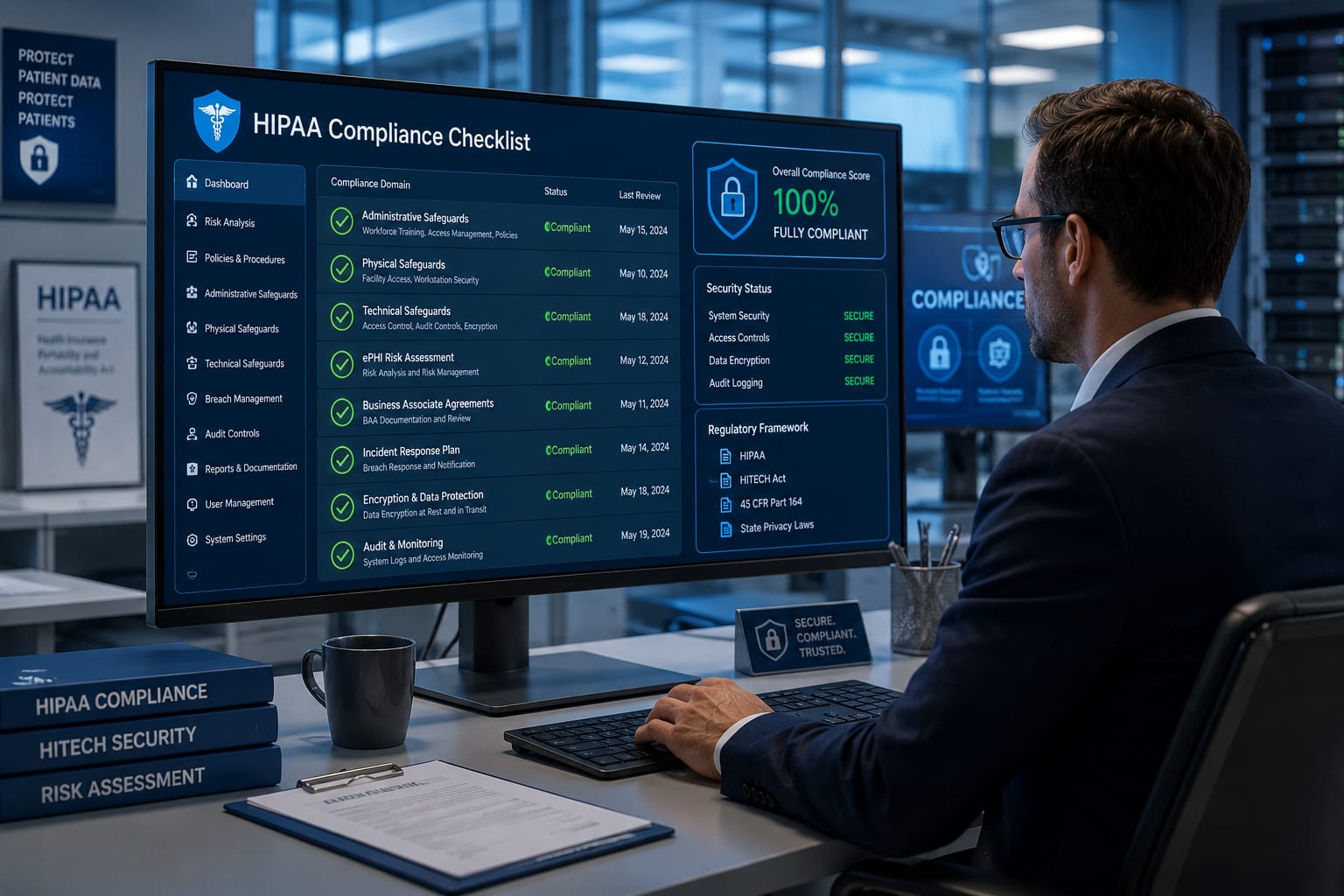
The HIPAA Security Rule compliance requirements that mattered in 2020 are not the same ones that will hold up in an OCR audit today. The threat landscape changed. Enforcement changed. And the technology healthcare organizations use to store, process, and transmit protected health information changed dramatically. Secure Traces Healthcare and Pharmacy Technology practice supports covered entities and business associates through exactly this kind of compliance complexity, where the regulatory text is static but the implementation requirements keep shifting.
This HIPAA Security Rule compliance checklist is built for healthcare IT teams that need to work through all three safeguard categories systematically: administrative, physical, and technical. It maps each standard to its HIPAA citation, provides implementation criteria, and flags where OCR enforcement has concentrated in recent years. Secure Traces Cybersecurity practice brings 24/7 SOC monitoring and HIPAA-aligned security operations to the technical safeguard requirements that are hardest to satisfy with in-house resources alone.
Why the HIPAA Security Rule Is More Demanding in 2026 Than It Was Five Years Ago
The HIPAA Security Rule text has not changed, but what counts as reasonable and appropriate under its flexible standard has shifted significantly. The Office for Civil Rights uses current industry practice as its benchmark when assessing whether a covered entity exercised appropriate diligence. That benchmark moved in three ways since 2021.
Enforcement Concentration Has Shifted to Specific Standards
OCR enforcement actions from 2022 through 2025 concentrated on a narrow set of repeat failures: missing or outdated risk analyses, inadequate audit controls, failure to execute Business Associate Agreements, and insufficient workforce training. These are not complex requirements to understand. They are compliance fundamentals that organizations fail to maintain over time. If your checklist shows gaps in any of these four areas, those are the items to address first.
The Breach Cost Calculation Changed
Healthcare remains the industry with the highest average data breach cost of any sector. The numbers below put the compliance investment in context against the cost of a breach and an enforcement action.
| METRIC | 2022 | 2024 | 2026 PROJECTION |
|---|---|---|---|
| Average cost per healthcare breach | $10.93M | $9.77M | $11.4M+ |
| Days to identify and contain breach | 329 | 194 | Under 180 (with SIEM) |
| Percentage of breaches involving PHI | 81% | 79% | 78% (est.) |
| OCR civil monetary penalty ceiling per violation | $50,000 | $50,000 | $50,000 |
| Average OCR penalty (resolved cases) | $1.2M | $2.1M | $3M+ (est.) |
The Technology Baseline for Reasonable and Appropriate Controls Moved
In 2026, single-factor authentication for systems containing PHI is not considered reasonable and appropriate by OCR. Neither is the absence of centralized audit logging or the absence of a documented incident response procedure. These were once optional safeguards that progressive organizations implemented. They are now the baseline that auditors and enforcement staff expect to see as a matter of course.
How to Use This HIPAA Security Rule Compliance Checklist
This checklist is structured for use in a formal compliance review. For each item, record the current implementation status (Implemented, Partially Implemented, Not Implemented, or Not Applicable) and the evidence you would produce in an audit. Not Applicable items require a documented rationale.
Work through the checklist in this order: administrative safeguards first, then physical, then technical. Administrative safeguards define the governance framework that all other controls operate within. A gap in the risk analysis, for example, invalidates much of what you think you know about your technical control effectiveness.
Complete HIPAA Security Rule Compliance Checklist
Use the table below to track implementation status and evidence for each HIPAA Security Rule standard and specification. Column three uses the following codes: I = Implemented, PI = Partially Implemented, NI = Not Implemented, N/A = Not Applicable with documented rationale.
| SAFEGUARD CATEGORY | HIPAA REQUIREMENT | IMPLEMENTATION STATUS | EVIDENCE / NOTES |
|---|---|---|---|
| Access Control (164.312(a)(1)) | Unique user IDs for all workforce members | ||
| Access Control (164.312(a)(1)) | Emergency access procedure documented | ||
| Access Control (164.312(a)(1)) | Automatic logoff after session timeout | ||
| Access Control (164.312(a)(1)) | Encryption and decryption mechanisms in place | ||
| Audit Controls (164.312(b)) | Hardware, software, and application audit logs enabled | ||
| Audit Controls (164.312(b)) | Audit logs reviewed on defined schedule | ||
| Audit Controls (164.312(b)) | Log retention meets organizational and state requirements | ||
| Audit Controls (164.312(b)) | SIEM or centralized log management in place | ||
| Integrity (164.312(c)(1)) | PHI integrity controls implemented | ||
| Integrity (164.312(c)(1)) | Transmission integrity verified (checksums or equivalent) | ||
| Transmission Security (164.312(e)(1)) | Encryption for PHI in transit (TLS 1.2 or higher) | ||
| Transmission Security (164.312(e)(1)) | Open network transmission controls documented | ||
| Person Authentication (164.312(d)) | Multi-factor authentication deployed for PHI-access systems | ||
| Risk Analysis (164.308(a)(1)(ii)(A)) | Risk analysis completed and documented | ||
| Risk Analysis (164.308(a)(1)(ii)(A)) | Risk analysis updated within last 12 months | ||
| Risk Management (164.308(a)(1)(ii)(B)) | Risk management plan active and assigned | ||
| Workforce Training (164.308(a)(5)) | Security awareness training completed by all workforce | ||
| Workforce Training (164.308(a)(5)) | Training records retained | ||
| Contingency Plan (164.308(a)(7)) | Data backup plan documented and tested | ||
| Contingency Plan (164.308(a)(7)) | Disaster recovery plan in place | ||
| Contingency Plan (164.308(a)(7)) | Emergency mode operation plan documented | ||
| BAA Management (164.308(b)(1)) | Business Associate Agreements executed with all BAs | ||
| BAA Management (164.308(b)(1)) | BAA inventory reviewed within last 12 months | ||
| Incident Response (164.308(a)(6)) | Security incident procedures documented | ||
| Incident Response (164.308(a)(6)) | Breach notification process defined and tested | ||
| Physical Safeguards (164.310) | Facility access controls in place for PHI systems | ||
| Physical Safeguards (164.310) | Workstation use and security policies enforced | ||
| Physical Safeguards (164.310) | Device and media controls for PHI-bearing hardware | ||
| Monitoring (Ongoing) | 24/7 security monitoring active for PHI systems | ||
| Monitoring (Ongoing) | Vulnerability scanning on defined schedule | ||
| Monitoring (Ongoing) | Penetration testing completed within last 12 months |
Need help closing HIPAA compliance gaps? Secure Traces provides HIPAA-aligned security operations and SOC services for covered entities and business associates. securetraces.com/contact
Administrative Safeguards: What Healthcare IT Teams Get Wrong
Talk to Secure Traces
Need help applying this to your environment?
Our team can translate these ideas into a roadmap, architecture review, or pilot for your organization.
Administrative safeguards account for the largest share of HIPAA Security Rule requirements and the largest share of OCR enforcement actions. They cover how your organization governs PHI security, not just what technical tools you deploy.
Risk Analysis Is Not a One-Time Event
The risk analysis requirement at 164.308(a)(1)(ii)(A) is the most cited deficiency in OCR enforcement. The standard requires a thorough and accurate assessment of potential risks and vulnerabilities to PHI confidentiality, integrity, and availability. In practice this means: documenting all PHI locations and data flows, identifying threats and vulnerabilities, assessing likelihood and impact, and documenting findings in a format that supports ongoing risk management.
What organizations consistently fail to do is keep the risk analysis current. A risk analysis completed in 2022 and not updated since does not reflect your current EHR configuration, cloud environment, workforce size, or vendor relationships. OCR treats an outdated risk analysis as equivalent to no risk analysis in enforcement proceedings.
Business Associate Agreement Inventory Management
Most organizations execute BAAs when they sign vendor contracts. Fewer organizations maintain a living inventory of all agreements, validate that agreements cover current PHI access scope, and update agreements when operations change. OCR has cited BAA gaps in enforcement actions where the organization had agreements in place but the agreements were outdated or did not cover the actual PHI access occurring.
The BAA inventory check on this checklist requires you to confirm not just that agreements exist but that they are current, that they reflect actual data flows, and that they have been reviewed within the last 12 months.
Workforce Training Records Are Evidence, Not Just Compliance
Training completion records are the evidence you produce when OCR asks how you satisfied 164.308(a)(5). Many organizations conduct training but do not retain documentation that individual workforce members completed it. Training records should identify the individual, the date, the training content, and the version of the content presented. Generic completion attestations without individual records do not satisfy the evidentiary standard.
Technical Safeguards: The Six Standards Healthcare IT Teams Must Get Right
Technical safeguards under 164.312 cover the technology controls that protect PHI at rest, in use, and in transit. The six standards are access control, audit controls, integrity controls, transmission security, person authentication, and (less commonly discussed) automatic logoff.
Access Control (164.312(a)(1)): Minimum Necessary at the System Level
Access control requires that only authorized users can access PHI, and that their access is limited to what they need for their role. In practice this means role-based access controls mapped to workforce functions, not broad permissions granted by default. It also means a process for promptly removing or modifying access when workforce members change roles or leave the organization. Systems that grant broad PHI access because access management is operationally inconvenient do not satisfy this standard.
Audit Controls (164.312(b)): Logging Is Not Enough
The audit controls standard requires mechanisms to record and examine access and activity in PHI systems. Enabling logging satisfies the record requirement. The examine requirement demands that logs actually be reviewed. Organizations that enable logging and never review it, or review it only after a breach, do not satisfy 164.312(b). In 2026, centralized log management through a SIEM platform combined with automated anomaly detection is the operational approach that satisfies both the record and examine requirements at scale.
The Secure Traces SOC Automation platform provides continuous PHI system monitoring with automated alerting that directly addresses the examine requirement of 164.312(b) without requiring in-house staff to manually review logs around the clock.
Transmission Security (164.312(e)(1)): TLS 1.2 Is the Floor
Transmission security requires that PHI transmitted over open networks is protected against unauthorized access. In 2026, TLS 1.0 and TLS 1.1 are deprecated and their use for PHI transmission represents a gap. TLS 1.2 is the minimum acceptable version, and TLS 1.3 is the current standard. Any system that transmits PHI to external parties, cloud services, or partner organizations needs a current encryption configuration review.
Person Authentication (164.312(d)): The MFA Reality
As noted above, person authentication does not name multi-factor authentication but effectively requires it in the current threat environment. The implementation specification requires that covered entities verify that a person seeking access to PHI is the person they claim to be. Single-factor authentication via username and password has been demonstrated to be insufficient for this purpose given current credential theft attack volumes. Organizations that have not deployed MFA for PHI-access systems should treat this as a priority remediation item.
Integrity Controls (164.312(c)(1)): Protecting Against Unauthorized Alteration
Talk to Secure Traces
Need help applying this to your environment?
Our team can translate these ideas into a roadmap, architecture review, or pilot for your organization.
Integrity controls protect PHI from being improperly altered or destroyed. This requires both controls on who can modify PHI and mechanisms to detect unauthorized modification. In practice: audit trails for PHI modification events, checksums or hash verification for data transfers, and version control for clinical documentation systems.
Secure Traces OT Security and Cybersecurity practices provide technical safeguard implementation support for healthcare covered entities and business associates. securetraces.com/services/cybersecurity
Physical Safeguards: Often Overlooked, Consistently Cited
Physical safeguards under 164.310 cover controls on physical access to PHI systems, workstation security, and device management. They are often underweighted in compliance programs that focus heavily on technical controls.
Workstation Security in a Hybrid Work Environment
The workstation use specification at 164.310(b) requires organizations to define appropriate use of workstations that access PHI and implement physical safeguards for those workstations. In a hybrid work environment where workforce members access PHI from home, the physical safeguard requirements extend to those remote environments. Organizations need policies that define acceptable workstation environments for PHI access and procedures for reporting workstation security incidents.
Device and Media Controls: Tracking PHI-Bearing Hardware
The device and media controls standard at 164.310(d)(1) requires policies and procedures for the receipt and removal of hardware and electronic media containing PHI. This covers laptops, mobile devices, USB drives, backup media, and server hardware. Organizations need a hardware inventory that tracks PHI-bearing devices, media sanitization procedures for decommissioned hardware, and documented accountability for device transfers.
How to Conduct a HIPAA Security Rule Compliance Assessment: Six Steps
A compliance assessment using this checklist is most effective when it follows a defined process that connects gap identification to remediation planning.
Step 1: Inventory all PHI systems and data flows. Document every system, application, and workflow that creates, receives, maintains, or transmits PHI, including cloud services, EHR integrations, and third-party vendor access. You cannot assess what you have not documented.
Step 2: Complete the risk analysis. Identify threats and vulnerabilities to PHI confidentiality, integrity, and availability. Assess the likelihood and impact of each threat. Document findings in a formal risk analysis report that maps to each HIPAA Security Rule standard.
Step 3: Map current controls against each safeguard standard. Work through each HIPAA Security Rule standard and addressable implementation specification using this checklist. For each item, document the current control, its effectiveness, and any gaps between current state and the standard.
Step 4: Prioritize and remediate gaps. Rank identified gaps by risk score derived from the risk analysis. Develop a risk management plan that assigns ownership, resources, and timelines to each remediation item.
Step 5: Validate Business Associate Agreements. Review the BA inventory and confirm current BAAs are in place for all vendors with PHI access. Update any BAAs that do not reflect current operations or that predate the HIPAA Omnibus Rule requirements.
Step 6: Implement continuous monitoring. Deploy a SIEM or managed SOC to satisfy the audit controls and ongoing risk management requirements. Document the monitoring program and integrate it into the risk management plan so that monitoring outputs feed future risk analysis updates.
How a Managed SOC Addresses HIPAA Security Rule Requirements
Several HIPAA Security Rule requirements are difficult for most healthcare organizations to satisfy with in-house resources at the level of rigor OCR now expects. A managed SOC that operates under a Business Associate Agreement addresses these requirements directly. The Secure Traces SOC Automation platform is built for exactly this use case.
Audit Controls (164.312(b))
A managed SOC ingests logs from all PHI-bearing systems continuously, applies automated detection logic to surface anomalous access patterns, and provides documented review activity. This satisfies both the record and examine requirements of 164.312(b) at a scale that manual log review cannot match.
Talk to Secure Traces
Need help applying this to your environment?
Our team can translate these ideas into a roadmap, architecture review, or pilot for your organization.
Incident Response (164.308(a)(6))
A managed SOC provides documented security incident procedures, 24/7 detection and response capability, and post-incident reporting that feeds breach notification assessments. The incident documentation produced by a SOC is the evidence you present in an OCR investigation to demonstrate that security incidents were identified, documented, and responded to appropriately.
Risk Management (164.308(a)(1)(ii)(B))
Ongoing SOC monitoring generates the security event data that feeds a living risk management program. Patterns in security events, vulnerability scan results, and threat intelligence inform risk analysis updates and risk management plan adjustments. A managed SOC turns risk management from a periodic document exercise into a continuously updated operational practice.
Contact Secure Traces to evaluate how a managed SOC can address your HIPAA Security Rule technical safeguard and audit control requirements. securetraces.com/contact
Key Takeaways
- The HIPAA Security Rule compliance checklist covers all three safeguard categories: administrative (risk analysis, training, BAA management, incident response, contingency planning), physical (facility access, workstation security, device controls), and technical (access control, audit logging, integrity, transmission security, person authentication).
- OCR enforcement from 2022 through 2025 concentrated on four repeat failures: missing or outdated risk analyses, inadequate audit controls, absent Business Associate Agreements, and insufficient workforce training documentation.
- A risk analysis must be current, meaning updated within the last 12 months and after any significant operational or technology change. An outdated risk analysis is treated as no risk analysis in enforcement proceedings.
- Multi-factor authentication is the effective minimum for person authentication (164.312(d)) in 2026. Single-factor authentication for PHI-access systems is no longer considered reasonable and appropriate given current credential theft attack volumes.
- Audit controls (164.312(b)) require both recording and examining PHI system activity. Enabling logging without a review process does not satisfy the standard. Centralized SIEM or managed SOC monitoring is the operational approach that satisfies both requirements at scale.
- Business Associate Agreements must be current, cover actual PHI data flows, and be reviewed at least annually. Outdated or incomplete BAAs have been cited in OCR enforcement actions even where agreements existed.
- Transmission security requires TLS 1.2 as a minimum in 2026. TLS 1.0 and TLS 1.1 are deprecated and their use for PHI transmission represents a compliance gap.
- A managed SOC that operates under a BAA directly addresses three HIPAA Security Rule requirements: audit controls, incident response, and ongoing risk management, at a level of rigor that in-house resources typically cannot match.
Frequently Asked Questions
What does a HIPAA Security Rule compliance checklist cover?
A HIPAA Security Rule compliance checklist covers all three safeguard categories required under 45 CFR Part 164: administrative safeguards (risk analysis, workforce training, contingency planning, incident response, BAA management), physical safeguards (facility access controls, workstation security, device controls), and technical safeguards (access controls, audit logging, integrity controls, transmission security, person authentication). A complete checklist maps each safeguard to its HIPAA citation, current implementation status, and the evidence needed to demonstrate compliance.
How often should a HIPAA risk analysis be updated?
HIPAA requires a risk analysis to be conducted periodically, meaning whenever environmental or operational changes occur that could affect the security of PHI. The Office for Civil Rights expects risk analyses to be updated at least annually and after significant changes such as new technology deployments, mergers, or major workflow changes. Organizations that cannot demonstrate a current risk analysis are at heightened risk in OCR audits.
What is the penalty for a HIPAA Security Rule violation?
HIPAA Security Rule civil monetary penalties are tiered by culpability. Violations with no knowledge carry a minimum penalty of $141 per violation up to an annual cap of $71,162. Violations due to willful neglect not corrected can reach $71,162 per violation with no annual cap. The OCR has imposed penalties above $3 million for systemic failures such as missing risk analyses, inadequate audit controls, and failure to execute Business Associate Agreements.
What does HIPAA require for audit controls in 2026?
Under 164.312(b), covered entities and business associates must implement hardware, software, and procedural mechanisms to record and examine access and other activity in information systems containing PHI. In practice this means enabling audit logging on all systems that store, process, or transmit PHI, centralizing logs through a SIEM platform, reviewing logs on a defined schedule, and retaining logs for a period that meets both HIPAA and applicable state requirements. Continuous monitoring through a managed SOC satisfies the ongoing review requirement.
Is multi-factor authentication required by HIPAA?
HIPAA does not mandate MFA by name, but the person authentication standard at 164.312(d) requires covered entities to verify that a person seeking access to PHI is who they claim to be. OCR guidance and enforcement actions make clear that single-factor authentication for systems containing PHI is no longer considered reasonable and appropriate given current threat conditions. In practice, MFA is now the minimum expected control for any PHI-access system, and OCR has cited inadequate authentication in multiple enforcement actions.
What is the difference between a HIPAA covered entity and a business associate?
A covered entity is a healthcare provider, health plan, or healthcare clearinghouse that creates, receives, maintains, or transmits PHI. A business associate is any third party that performs a function or activity on behalf of a covered entity that involves access to PHI, such as a cloud hosting provider, managed SOC vendor, billing service, or EHR vendor. Business associates must sign a Business Associate Agreement and are directly subject to HIPAA Security Rule requirements under the HITECH Act.
How does a managed SOC help with HIPAA Security Rule compliance?
A managed SOC directly addresses several HIPAA Security Rule requirements. For audit controls (164.312(b)), a SOC provides continuous log ingestion and review that manual processes cannot match. For incident response (164.308(a)(6)), a SOC provides 24/7 detection and documented response procedures. For risk management (164.308(a)(1)(ii)(B)), a SOC generates the ongoing monitoring data that feeds the risk management plan. SOC providers that handle PHI must sign a Business Associate Agreement and operate under HIPAA-aligned data handling procedures.
About the author

Founder & CEO, Secure Traces
30+ years in enterprise cybersecurity · Former Verint · Former GE
Natraj is the Founder and CEO of Secure Traces with over three decades of experience in enterprise cybersecurity, cloud infrastructure, and IT modernization. He has held senior security and architecture roles at Verint and GE, and advises boards on AI governance, SOC modernization, and cyber-risk strategy.