Cybersecurity · Healthcare
AI-Powered Threat Detection vs Traditional SIEM: What Healthcare CISOs Need to Know
Healthcare CISOs weighing AI-powered threat detection against traditional SIEM need a clear comparison of detection accuracy, alert fatigue, dwell time, staffing requirements, and cost. This guide covers everything that matters for the decision in 2026.
The Secure Traces Cybersecurity practice operates a managed SOC that combines traditional SIEM with AI-powered XDR detection, providing 24x7 coverage calibrated to the behavioral patterns of healthcare environments. The Secure Traces AI Solutions practice delivers AI-powered detection capabilities including behavioral analytics tuned to clinical user workflows and medical device communication baselines.
Traditional SIEM platforms have anchored security operations for the better part of two decades, and their core function is straightforward: collect log data from across the environment, apply correlation rules to identify patterns that indicate malicious activity, and generate alerts for analyst review. In the environments of the early 2000s, when log volumes were manageable, threat actor tactics were less sophisticated, and the attack surface was primarily defined by on-premises network perimeters, this approach was workable.
The environment in which healthcare CISOs operate today is categorically different. Log volumes have grown by orders of magnitude as healthcare organizations have adopted cloud platforms, expanded their device estate into tens of thousands of networked clinical devices, and connected to external partner environments through dozens of integration points. Threat actors have adopted techniques specifically designed to evade rule-based detection, operating slowly and deliberately to stay below the threshold of the correlation rules that SIEM platforms use to generate alerts. And the volume of alerts that traditional SIEM platforms generate has grown to the point where analyst teams cannot review all of them, creating the alert fatigue conditions under which genuine threats are missed.
AI-powered threat detection platforms, including the AI-driven capabilities now embedded in leading XDR and MDR platforms, offer a fundamentally different approach to these problems. But understanding what AI-powered detection actually delivers, where it outperforms traditional SIEM, where traditional SIEM remains valuable, and how to make an informed architecture decision requires cutting through substantial vendor marketing to reach the technical substance of the comparison.
This article provides healthcare CISOs with the analytical framework needed to evaluate AI-powered threat detection against traditional SIEM across the dimensions that matter most for healthcare security operations.
What Traditional SIEM Does and Where It Struggles
A traditional SIEM platform performs two core functions: log aggregation and correlation rule-based alerting. It collects log data from endpoints, network devices, identity systems, applications, and cloud platforms, normalizes that data into a common format, stores it for a defined retention period, and applies a library of correlation rules that generate alerts when log patterns match predefined threat signatures.
The strengths of traditional SIEM are real and should not be understated. As a log aggregation and retention platform, SIEM provides the centralized data store that satisfies audit log retention requirements under HIPAA and other healthcare regulations, enables forensic investigation of security incidents by providing historical log data, and supports compliance reporting that demonstrates control effectiveness to auditors and regulators. These functions remain valuable regardless of what detection methodology overlays the log data.
However, the detection effectiveness of traditional SIEM is constrained by several structural characteristics of the rule-based correlation approach.
Rules require known attack patterns. Correlation rules are written by security engineers who observe known attack techniques and encode the log signatures of those techniques into detection logic. A rule can only detect what its author anticipated. Novel attack techniques, zero-day exploits, and threat actor methods that deliberately deviate from known patterns to avoid detection will not match existing rules and will not generate alerts. In healthcare, where threat actors have spent years studying the specific environments, workflows, and monitoring patterns of hospital security teams, the assumption that correlation rules will catch attacks in progress is increasingly unreliable.
Rule maintenance is continuous and resource intensive. The threat landscape changes continuously, and correlation rules that were relevant six months ago may miss current attack techniques. Maintaining a SIEM rule library that accurately reflects the current threat landscape requires dedicated security engineering resources who continuously update rules as new threat intelligence becomes available. Most healthcare security teams do not have the dedicated resources needed to maintain their rule libraries at the pace that the threat landscape demands, and many organizations run SIEM platforms with rule libraries that were tuned at deployment and have not been meaningfully updated since.
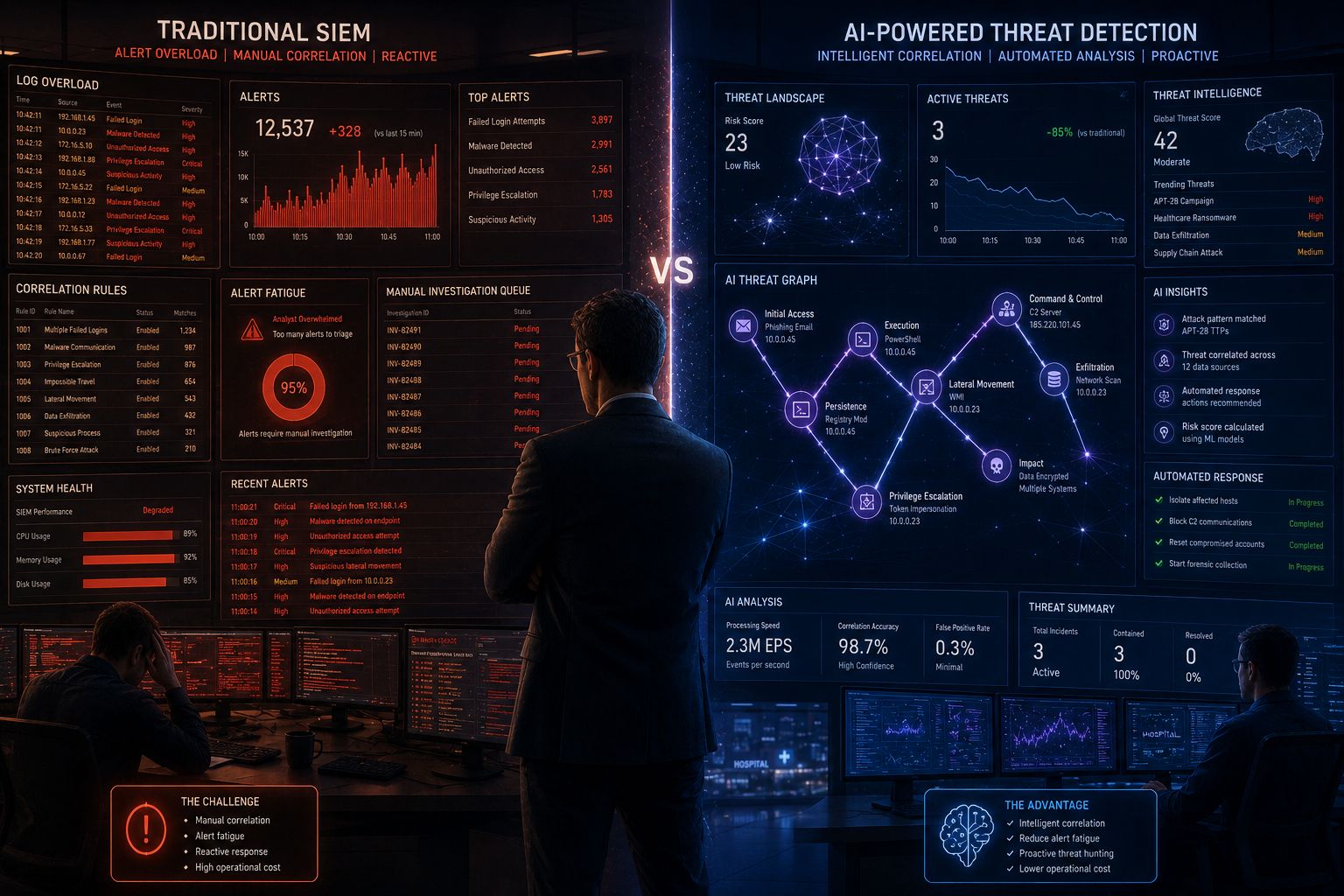
Alert volume overwhelms analyst capacity. A traditional SIEM deployed in a large healthcare environment may generate thousands of alerts per day. The vast majority of these alerts are false positives generated by legitimate user behavior, system processes, and network activity that superficially matches a correlation rule but is not actually malicious. Analysts who must review thousands of alerts per day to identify the small number of genuine threats experience alert fatigue, a documented psychological condition in which high-volume alert environments lead to missed detections as analysts begin dismissing alerts without adequate review.
The consequences of alert fatigue in a healthcare environment are severe. A genuine ransomware precursor activity alert dismissed by a fatigued analyst because it resembles hundreds of similar false positives from the previous week can result in a full ransomware deployment days or weeks later that the team had the data to prevent.
Talk to Secure Traces
Need help applying this to your environment?
Our team can translate these ideas into a roadmap, architecture review, or pilot for your organization.
Dwell time remains unacceptably long. Industry data consistently shows that the average dwell time for attackers in enterprise environments, meaning the time between initial compromise and detection, has remained stubbornly high despite widespread SIEM deployment. Attackers who understand the correlation rules and thresholds of traditional SIEM platforms operate deliberately within the gaps between rules, moving slowly enough that no single log event triggers an alert even while the cumulative pattern of their activity clearly indicates compromise. Detecting these slow-burn attacks requires connecting behavioral patterns across extended time windows that traditional correlation rules are not designed to analyze.
What AI-Powered Threat Detection Actually Does
AI-powered threat detection platforms use machine learning models trained on large datasets of both malicious and benign security telemetry to identify anomalous and potentially malicious behavior without requiring a human analyst to encode the detection logic as an explicit rule. Understanding what specific AI and machine learning techniques are applied and what detection problems each technique addresses is important for evaluating vendor claims and comparing platforms.
User and entity behavior analytics. UEBA uses machine learning to establish behavioral baselines for individual users, service accounts, and systems based on historical activity patterns, and then identifies deviations from those baselines that could indicate compromise or misuse. A user account that suddenly begins accessing patient records at 3 AM from a geographic location where the user has never logged in before, downloading volumes of data that exceed their historical norm by an order of magnitude, will generate an anomaly alert from a UEBA model even if the specific behavior pattern does not match any predefined correlation rule.
In healthcare, UEBA is particularly valuable for detecting compromised credential use, insider threat activity, and the lateral movement patterns that characterize ransomware precursor activity, because these activities typically appear as legitimate user behavior from the perspective of individual log events while their anomaly from the user behavioral baseline makes them detectable through UEBA analytics.
Graph-based threat correlation. Graph-based detection models represent the relationships between entities in the security environment, including users, endpoints, applications, network connections, and external IP addresses, as a graph structure and use machine learning to identify anomalous relationship patterns that indicate attack activity. An attacker conducting lateral movement across a network creates a characteristic pattern of new relationships between previously unconnected entities that a graph model can detect even when no individual event in the sequence triggers a correlation rule.
Natural language processing for threat intelligence integration. Modern AI-powered detection platforms use NLP to process threat intelligence feeds, security research publications, and incident reports, automatically extracting indicators of compromise and adversary tactics, techniques, and procedures described in unstructured text and translating them into detection logic without requiring a human to manually write correlation rules. This capability closes the gap between published threat intelligence and detection coverage far faster than manual rule development can achieve.
Supervised learning for malware and anomaly classification. Machine learning classification models trained on labeled datasets of known malware samples and benign executables can identify novel malware variants that share behavioral or structural characteristics with known malware families without requiring exact signature matches. This approach detects the polymorphic and metamorphic malware variants that signature-based antivirus and SIEM rules cannot catch.
Automated alert triage and prioritization. AI platforms can assess the risk context of each generated alert, considering factors including the identity and role of the affected user, the sensitivity of the systems involved, the similarity of the alert pattern to known attack sequences, and the relationship of the alert to other recent alerts, to produce a risk-prioritized alert queue where the highest-confidence, highest-impact detections are surfaced first. This dramatically reduces the analyst time required to identify the alerts that warrant immediate investigation from the larger volume that can be reviewed less urgently.
The Secure Traces Cybersecurity practice operates a managed SOC that combines SIEM platforms including Microsoft Sentinel, Splunk, and Exabeam with XDR platforms including CrowdStrike, SentinelOne, and Palo Alto Cortex XDR, and applies AI-driven behavioral analytics and threat correlation as a unified detection layer calibrated to the specific characteristics of healthcare environments.
The Healthcare-Specific Case for AI-Powered Detection
The general arguments for AI-powered threat detection apply across industries, but several characteristics of the healthcare security environment make AI-powered detection particularly valuable relative to traditional SIEM in this specific context.
Clinical workflow diversity creates complex behavioral baselines. Healthcare environments host an extraordinarily diverse user population including physicians, nurses, pharmacists, radiology technicians, administrative staff, biomedical engineers, and IT personnel, each with distinct and complex behavioral patterns. A physician who reviews patient records from home at midnight is exhibiting normal behavior. A billing clerk who does the same is exhibiting anomalous behavior. A traditional SIEM correlation rule that fires on after-hours EHR access would generate enormous false positive volumes in the physician population while potentially missing the same behavior in the billing clerk population. UEBA models that establish individual behavioral baselines for each user can distinguish these patterns with far greater precision.
Talk to Secure Traces
Need help applying this to your environment?
Our team can translate these ideas into a roadmap, architecture review, or pilot for your organization.
Medical device behavior is distinct from IT endpoint behavior. Clinical devices communicate with specific peer systems in highly consistent, predictable patterns. An infusion pump that begins communicating with an external IP address is behaving in a way that no correlation rule needs to encode because any deviation from the device expected communication pattern is anomalous. AI behavioral models trained on clinical device baselines can detect compromised device behavior with a sensitivity that rule-based systems cannot achieve.
Healthcare ransomware precursors have distinctive behavioral signatures. The documented precursor activity patterns that precede ransomware deployment in healthcare environments, including specific lateral movement techniques, credential harvesting behavior, reconnaissance patterns, and data staging activity, create multi-step behavioral sequences that AI-powered detection platforms can identify through graph-based correlation across extended time windows. Traditional SIEM platforms that evaluate each alert event independently are far less effective at detecting these multi-step sequences before the ransomware payload is deployed.
PHI data exfiltration has behavioral fingerprints. Large-scale PHI exfiltration, whether by external attackers or insider threats, creates behavioral signatures including abnormal data access volumes, unusual external transfer activity, and atypical query patterns against EHR data stores that AI anomaly detection can identify. A user who accesses 10,000 patient records in a single session when their historical norm is 20 records per session is exhibiting behavior that a UEBA model will flag even if the access appears individually legitimate from a permission standpoint.
The Secure Traces AI Solutions practice delivers AI-driven cybersecurity capabilities including behavioral threat detection models specifically tuned to healthcare environment characteristics, clinical device behavioral baselines, and EHR data access anomaly detection that address the healthcare-specific detection gaps that traditional SIEM correlation rules cannot fill.
The Cost and Staffing Comparison
For healthcare CISOs managing security programs under budget constraints, the total cost of ownership comparison between traditional SIEM and AI-powered detection platforms is a critical input to the architecture decision. This comparison is more nuanced than vendor pricing sheets suggest.
Traditional SIEM total cost components. The licensing cost of a traditional SIEM platform represents only a fraction of the total cost of ownership. Log ingestion and storage costs scale with data volume, and in a large healthcare environment with extensive clinical device telemetry, imaging system logs, and cloud platform data, log volume grows rapidly. Rule development and maintenance requires dedicated security engineering time. Alert triage and investigation requires analyst staffing to handle the alert volume the platform generates. Threat intelligence subscription costs add to the operating budget. Platform tuning, integration development, and ongoing management require either dedicated staff or managed service support.
AI-powered detection platform total cost components. AI-powered XDR and detection platforms typically include both the technology and a defined level of threat intelligence, detection model updates, and sometimes managed analyst services within their licensing structure. The platform investment is generally higher than a bare SIEM license, but the reduction in analyst hours required for alert triage and the reduction in security engineering hours required for rule maintenance can offset the higher platform cost, particularly for healthcare organizations with limited security staff.
The staffing leverage calculation. The most significant economic argument for AI-powered threat detection in healthcare is the staffing leverage it provides. Healthcare organizations face a severe cybersecurity talent shortage, and qualified security analysts command compensation that continues to escalate. A traditional SIEM that generates 5,000 alerts per day requires a staffing model sized to review that alert volume. An AI-powered detection platform that applies automated triage and prioritization to generate 50 high-confidence, actionable alerts per day from the same telemetry requires a fraction of the analyst capacity, allowing the same team to cover more ground with greater effectiveness.
The cost of undetected threats. Any cost comparison that evaluates detection platforms solely on technology and staffing costs without accounting for the cost of the threats that each approach fails to detect is incomplete. The average cost of a healthcare data breach in 2024 exceeded $10 million, and ransomware attacks that disable clinical operations have demonstrated costs ranging from tens of millions to hundreds of millions of dollars when all costs including response, recovery, regulatory penalties, and litigation are included. The detection capability delta between traditional SIEM and AI-powered platforms, measured in reduced dwell time and earlier precursor detection, translates directly into breach prevention value that should be included in the total cost of ownership analysis.
XDR as the Integration Point
Extended detection and response, known as XDR, has emerged as the architecture that integrates AI-powered detection capabilities with the log aggregation and investigation capabilities of traditional SIEM into a unified security operations platform. Understanding XDR is important for healthcare CISOs evaluating detection architecture decisions because most mature AI-powered threat detection deployments today take the form of XDR rather than standalone AI detection tools.
An XDR platform collects telemetry from endpoints, networks, identity systems, email, and cloud environments through native sensor integrations rather than relying solely on log forwarding. This native telemetry collection provides richer behavioral data than log files alone, enabling the behavioral analytics that AI-powered detection requires. XDR platforms then apply AI and machine learning detection across this telemetry to identify threats, correlate related detections into unified incidents, and provide the investigation and response tools that analysts use to contain and remediate confirmed threats.
Talk to Secure Traces
Need help applying this to your environment?
Our team can translate these ideas into a roadmap, architecture review, or pilot for your organization.
Leading XDR platforms in the healthcare market include CrowdStrike Falcon, SentinelOne Singularity, Microsoft Defender XDR, and Palo Alto Cortex XDR, each of which can be integrated with SIEM platforms including Microsoft Sentinel, Splunk, and Exabeam to create a layered architecture that combines XDR behavioral detection with SIEM log retention and compliance reporting.
The Secure Traces Cybersecurity practice delivers managed XDR services across all of these platforms, providing healthcare organizations with the AI-powered detection capability of leading XDR platforms combined with 24x7 analyst coverage through the Secure Traces managed SOC, without requiring the internal staffing that operating these platforms independently demands.
Making the Architecture Decision: A Framework for Healthcare CISOs
Healthcare CISOs evaluating their detection architecture should work through a structured decision framework that addresses the specific characteristics of their environment rather than applying a generic enterprise security recommendation.
Assess current detection effectiveness honestly. Before evaluating alternative detection approaches, measure the actual performance of the current detection environment. What is the current mean time to detect? What percentage of alerts are investigated versus dismissed due to volume? How many confirmed breaches or near-miss incidents in the past 24 months went undetected for more than 24 hours? What percentage of alerts are false positives? Honest answers to these questions establish the baseline against which any alternative approach must be evaluated.
Map the specific threat scenarios that matter most. For most healthcare organizations, the priority threat scenarios include ransomware precursor detection, compromised credential use, PHI mass exfiltration, and medical device compromise. Evaluate each detection platform option against its documented effectiveness for each of these specific scenarios in healthcare environments rather than against generic detection benchmark claims.
Evaluate staffing requirements honestly. Be realistic about current and projected security analyst capacity. A detection architecture that requires alert review staffing that cannot be sustained within budget creates operational risk regardless of its theoretical detection capability. Factor the staffing leverage of AI-powered detection into the total cost of ownership calculation rather than comparing platform licensing costs in isolation.
Consider a hybrid architecture. For most healthcare organizations, the right architecture is not a choice between traditional SIEM and AI-powered detection but a combination that uses each for what it does best. Traditional SIEM provides log aggregation, long-term retention for compliance, and forensic investigation capability. AI-powered XDR provides behavioral detection, automated alert triage, and threat correlation across the telemetry that drives high-confidence, low-volume actionable alerting. Integrating both into a managed SOC function with 24x7 analyst coverage delivers the combination of compliance capability and detection effectiveness that healthcare security operations require.
Evaluate managed service options. Building and operating a mature AI-powered detection capability internally requires platform expertise, dedicated security engineering resources for model tuning and integration development, and analyst staffing for 24x7 coverage. For healthcare organizations without these internal resources, managed SOC services that operate AI-powered XDR platforms on their behalf provide access to advanced detection capability without the internal resource requirements that building the same capability independently would demand.
To learn how Secure Traces can assess your current detection architecture and recommend the right combination of SIEM, XDR, and managed SOC services for your healthcare environment, contact Secure Traces to schedule a security operations assessment.
Conclusion
The question for healthcare CISOs in 2026 is not whether to use SIEM or AI-powered threat detection. It is how to combine both capabilities into a security operations architecture that delivers the detection effectiveness the threat landscape demands, the compliance documentation that regulatory requirements mandate, and the staffing leverage that finite security budgets require.
Traditional SIEM remains valuable as a log aggregation, retention, and compliance reporting platform. Its limitations as a primary detection mechanism in modern healthcare environments, where threat actor sophistication has outpaced rule-based detection methodology, are real and documented. AI-powered behavioral detection through XDR platforms addresses these limitations by detecting novel attack patterns, identifying slow-burn lateral movement campaigns, reducing alert volumes through automated triage, and delivering the earlier detection that reduces dwell time and the blast radius of successful attacks.
The healthcare organizations that will suffer the most damaging breaches in the coming years are those that continue to rely exclusively on traditional SIEM correlation rules as their primary detection mechanism while the threat actors targeting them operate with tools and techniques specifically designed to evade those rules. The organizations that close this gap by integrating AI-powered detection into their security operations architecture, with 24x7 analyst coverage to act on the high-confidence detections that AI surfaces, will detect and contain threats before they become catastrophic incidents.
About the author

Founder & CEO, Secure Traces
30+ years in enterprise cybersecurity · Former Verint · Former GE
Natraj is the Founder and CEO of Secure Traces with over three decades of experience in enterprise cybersecurity, cloud infrastructure, and IT modernization. He has held senior security and architecture roles at Verint and GE, and advises boards on AI governance, SOC modernization, and cyber-risk strategy.