Cybersecurity · Healthcare
How to Build a Ransomware Incident Response Plan for a Healthcare Organization
Learn how to build a ransomware incident response plan for healthcare organizations. Covers detection, containment, HIPAA breach notification, and recovery with actionable steps.
Secure Traces Cybersecurity practice provides incident response retainer services with a 1-hour SLA, ensuring healthcare organizations have expert ransomware responders engaged before an attack begins. The Secure Traces Healthcare and Pharmacy Technology practice delivers HIPAA-aligned incident response planning that accounts for clinical continuity requirements alongside technical containment and breach notification obligations.
The organizations that recover fastest and with the least damage are not necessarily those with the most sophisticated security tools. They are the organizations that built, tested, and maintained a documented ransomware incident response plan before an attack occurred. When a ransomware actor activates encryption in the middle of the night, every minute of delay in the response costs money, patient safety, and regulatory standing. A tested plan converts that chaos into a sequence of defined actions executed by trained people with clear roles and accountabilities.
This article is a practical guide to building a ransomware incident response plan specifically designed for healthcare environments. It covers every phase of the response lifecycle from detection through recovery, addresses the HIPAA-specific obligations that make healthcare ransomware response uniquely complex, and provides the framework healthcare IT and security teams need to build a plan that will actually work under pressure.
Why Healthcare Ransomware Response Is Different
Before building a plan, it is important to understand why healthcare ransomware response carries requirements and constraints that do not apply to other industries.
Patient safety is a direct operational variable. In most industries, a ransomware attack creates financial and reputational consequences. In healthcare, it creates immediate patient safety risks. When EHR systems go offline, clinical staff lose access to medication records, allergy histories, and care plans. When imaging systems are encrypted, radiologists cannot read scans. When pharmacy automation systems are offline, medication dispensing requires manual processes that are slower and more error-prone. A ransomware incident response plan for a healthcare organization must account for clinical continuity as a first-order concern, not an afterthought.
HIPAA imposes a presumption of breach. Under the Department of Health and Human Services guidance, a ransomware attack against a covered entity is presumed to be a HIPAA breach unless the organization can demonstrate with a low probability determination that PHI was not accessed or acquired. This means that every healthcare ransomware response must include a parallel breach assessment track that documents the forensic evidence supporting or rebutting the breach presumption, because the organization may be required to notify affected individuals, the media, and HHS on a legally defined timeline.
Clinical systems cannot always be isolated immediately. Standard incident response guidance calls for rapid network isolation of compromised systems to prevent ransomware from spreading. In a clinical environment, immediately isolating a server or network segment may cut off access to life-critical systems. Containment decisions in a healthcare ransomware response require clinical input alongside security judgment, and playbooks must define tiered containment procedures that account for clinical risk.
Recovery sequencing must prioritize clinical operations. System restoration after a ransomware attack must follow a sequence that prioritizes the systems most critical to patient care, not simply the systems that are easiest to restore. This requires pre-defined recovery priority tiers that map clinical operational dependencies to specific systems and restoration timeframes.
The Six Phases of a Healthcare Ransomware Incident Response Plan
A complete healthcare ransomware incident response plan covers six sequential phases. Each phase has defined objectives, required actions, assigned roles, and documentation requirements.
Phase 1: Preparation
Preparation is everything that happens before a ransomware attack occurs. It is the phase that determines whether the response to an actual attack is controlled and effective or chaotic and slow. Most healthcare organizations that suffer catastrophic ransomware impacts did not fail during the attack. They failed during preparation.
Establish the Incident Response Team. A healthcare ransomware incident response team requires representatives from information security, IT operations, clinical informatics, legal and compliance, communications, and executive leadership. Each team member must have a documented role, a defined backup, and contact information that is accessible without relying on systems that may be encrypted during an attack.
The team structure should include:
An Incident Commander who has overall authority and accountability for the response. This role should be senior enough to make resource allocation decisions and authorize containment actions that affect clinical operations without requiring additional approval chains that slow response.
A Technical Lead from information security who owns the detection, analysis, and containment technical workstream. This person coordinates with the managed SOC provider if one is engaged, and owns the forensic evidence collection process.
A Clinical Operations Lead from clinical informatics or nursing informatics who advises on the patient safety implications of containment and recovery decisions and coordinates with clinical department heads during downtime procedures.
A Legal and Compliance Lead from the legal or compliance function who owns the HIPAA breach assessment process, coordinates with outside legal counsel, and manages regulatory notification timelines.
A Communications Lead who manages internal communications to staff, external communications to patients and media, and regulatory communications to HHS and state authorities.
Document the asset inventory and system criticality tiers. The foundation of an effective recovery plan is a current, accurate inventory of all systems in the environment with their criticality to clinical operations defined and documented. Systems should be classified into tiers such as: Tier 1 for systems whose loss immediately impacts patient safety, Tier 2 for systems whose loss significantly impairs clinical operations within hours, Tier 3 for systems whose loss impairs administrative operations but does not directly affect patient care, and Tier 4 for systems whose loss is operationally inconvenient but does not affect clinical or administrative operations materially.
EHR platforms, pharmacy automation systems, imaging systems, and clinical monitoring platforms typically fall in Tier 1. Laboratory information systems, scheduling platforms, and revenue cycle systems typically fall in Tier 2. HR and financial systems typically fall in Tier 3. Document management and collaboration tools typically fall in Tier 4.
Talk to Secure Traces
Need help applying this to your environment?
Our team can translate these ideas into a roadmap, architecture review, or pilot for your organization.
This tiering drives both containment decisions and recovery sequencing, so it must be accurate and current.
Maintain and test offline backups. Ransomware actors specifically target backup systems to maximize pressure on victims. Backups that are accessible from the network can be encrypted along with production data, eliminating the recovery option. Healthcare organizations must maintain at least one set of backups that is physically or logically isolated from the production environment and cannot be reached by a ransomware actor who has compromised network-connected systems.
Backup integrity must be verified through regular restoration testing. A backup that has never been successfully restored is a theoretical recovery option, not a reliable one. Restoration testing should be scheduled at minimum quarterly, with Tier 1 system backup restorations tested at least annually.
Develop and document downtime procedures. Every clinical process that depends on electronic systems must have a documented paper-based or offline backup procedure. These downtime procedures should be printed, stored in sealed envelopes in clinical areas, and reviewed at least annually so that clinical staff know where to find them and how to execute them before they need them under pressure.
Engage a cybersecurity partner with a healthcare incident response retainer. The speed of expert engagement after a ransomware event is detected directly determines the scope of damage. Organizations that must identify and engage a forensic firm after an attack begins lose hours or days of critical response time. A pre-negotiated incident response retainer with a cybersecurity firm that specializes in healthcare environments provides immediate access to trained responders, forensic tools, and HIPAA-specific expertise when minutes matter.
The Cybersecurity services practice at Secure Traces provides incident response retainer services with a 1-hour SLA and forensic imaging capabilities, giving healthcare organizations guaranteed rapid analyst engagement without the delay of identifying and contracting a response firm during an active attack.
Phase 2: Detection and Initial Assessment
Ransomware attacks are rarely instantaneous. The encryption event that triggers visible disruption is typically preceded by a period of attacker presence in the environment, often measured in days or weeks, during which the attacker establishes persistence, escalates privileges, identifies backup systems, and stages data for exfiltration before activating the ransomware payload.
The detection phase objective is to identify attacker presence as early as possible in this pre-encryption timeline, before encryption begins, so that containment can occur before damage is done. This requires continuous 24x7 security monitoring with behavioral analytics capable of detecting the lateral movement, credential theft, and backup enumeration activity that precede ransomware deployment.
Indicators of pre-ransomware activity to monitor:
Unusual lateral movement between systems, particularly involving administrative credentials or remote management tools. Ransomware actors commonly use legitimate remote administration tools like remote desktop protocol and remote management software to move between systems after gaining initial access.
Enumeration of backup systems and shadow copy deletion commands. Actors preparing for ransomware deployment frequently identify and disable or delete backup systems to maximize leverage. Commands that delete volume shadow copies or disable backup agents are high-confidence ransomware precursor indicators.
Large-scale data staging and exfiltration activity. Many ransomware groups now operate double extortion models where they exfiltrate data before encrypting it. Unusual outbound data transfer volumes, particularly to cloud storage services or unfamiliar external destinations, may indicate data staging for exfiltration.
Credential access and privilege escalation activity. Ransomware actors typically need to escalate from an initial low-privilege access point to domain administrator level credentials before they can execute encryption across the environment. Detection of tools like Mimikatz or techniques associated with MITRE ATT&CK credential access techniques should trigger immediate investigation.
When any of these indicators are detected, the initial assessment phase begins. The technical lead must determine the scope of potential compromise, which systems show evidence of attacker presence, and what the most likely entry point was. This assessment informs the containment decision and scope.
Phase 3: Containment
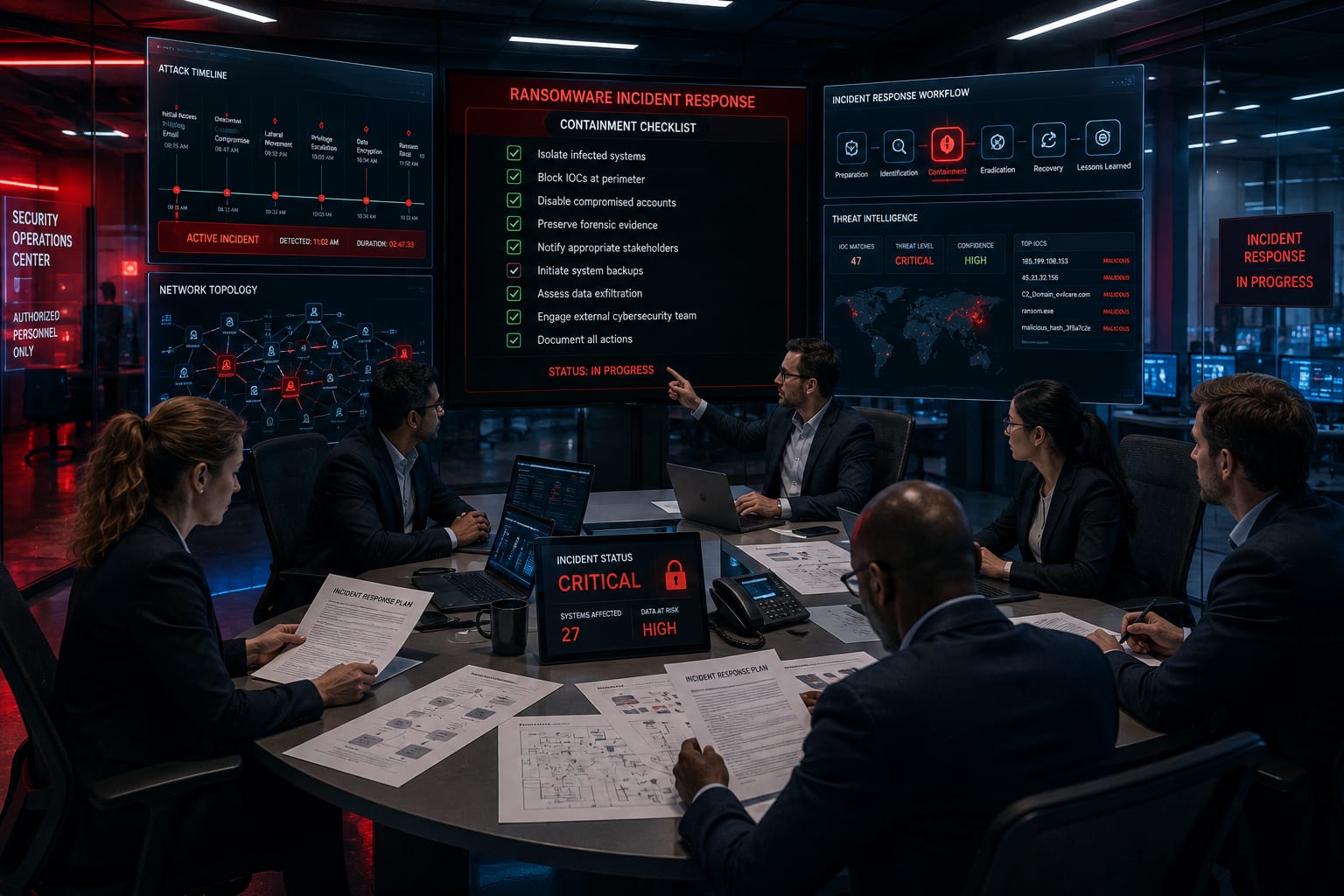
Containment is the most operationally complex phase of healthcare ransomware response because the standard approach of immediately isolating all potentially compromised systems conflicts directly with the clinical operational requirement to maintain access to life-critical systems.
Tiered containment for clinical environments:
Rather than applying a single blanket containment action, healthcare ransomware containment should proceed in tiers that balance containment effectiveness against clinical operational impact.
Tier A containment actions can be executed immediately without clinical consultation because they do not affect patient-facing systems. These include blocking known attacker infrastructure at the perimeter firewall, disabling compromised user accounts, isolating non-clinical systems confirmed to be compromised, and terminating suspicious remote access sessions.
Tier B containment actions affect administrative systems that support clinical operations indirectly and should be executed after notification to the incident commander and clinical lead but without waiting for extended clinical review. These include isolating administrative network segments, disabling remote desktop protocol access organization-wide, and activating downtime procedures for affected administrative systems.
Tier C containment actions affect clinical systems directly and require explicit sign-off from the incident commander and clinical lead before execution. These include isolating clinical network segments, taking EHR systems offline, and activating full clinical downtime procedures. The decision to execute Tier C containment must weigh the risk of continued attacker access against the patient safety risk of clinical system disruption, and this decision must be documented with the rationale clearly recorded.
Talk to Secure Traces
Need help applying this to your environment?
Our team can translate these ideas into a roadmap, architecture review, or pilot for your organization.
Preserve forensic evidence before containment. Before any system is shut down or isolated, forensic evidence must be preserved. This means capturing volatile memory, which contains encryption keys, network connections, and running process information that disappears when a system is powered off. It also means preserving system logs, which may be overwritten if systems remain running for extended periods. The technical lead should coordinate with the incident response partner to ensure forensic imaging is completed before containment actions that would destroy volatile evidence.
Activate downtime procedures. Once containment actions are initiated, all clinical areas affected by system outages must be notified and downtime procedures must be activated. Staff should receive clear communication about what systems are unavailable, what alternative procedures are in effect, and who to contact with operational questions. Confusion during the downtime period creates patient safety risks that compound the direct impact of the ransomware attack.
Phase 4: HIPAA Breach Assessment and Notification
This phase runs in parallel with the technical containment and investigation workstream and is owned by the legal and compliance lead with support from outside legal counsel and the technical team providing forensic evidence.
The HIPAA breach presumption. Under HHS guidance, a ransomware attack is presumed to be a HIPAA breach affecting the PHI in any system that the ransomware encrypted, accessed, or traversed. The covered entity can rebut this presumption only by demonstrating through a four-part low probability analysis that there is a low probability that PHI was compromised. This analysis evaluates the nature and extent of the PHI involved, who accessed or could have accessed the PHI, whether the PHI was actually acquired or viewed, and the extent to which the risk to PHI has been mitigated.
If the organization cannot satisfy the low probability standard, the ransomware event is a reportable HIPAA breach with the following notification obligations:
Affected individuals must be notified within 60 days of discovering the breach. For breaches affecting 500 or more individuals in a state or jurisdiction, media notification in that state is also required within 60 days. HHS must be notified without unreasonable delay. For breaches affecting 500 or more individuals, HHS notification must occur within 60 days of discovery and the breach will be posted on the HHS public breach portal.
Document the breach assessment process. Every step of the breach assessment, including the forensic evidence reviewed, the analysis applied, the conclusions reached, and the individuals involved in reaching those conclusions, must be documented and retained. This documentation is the evidence the organization would present if HHS investigates the breach response.
Prepare notification materials in advance. Healthcare organizations that have not prepared template breach notification letters, HHS reporting forms, and media statement frameworks before an attack must create them from scratch in the middle of an active incident response, when legal, security, and clinical teams are already at maximum capacity. Preparing these materials during the planning phase and updating them annually ensures they are ready to activate when needed.
Phase 5: Eradication and Recovery
Eradication removes the attacker from the environment completely before recovery begins. Recovering systems before eradication is complete allows the attacker to re-encrypt restored systems, which has happened to multiple healthcare organizations that restored from backup without first confirming the attacker was fully expelled.
Eradication steps:
Identify and close the initial access vector that the attacker used to enter the environment. Common initial access vectors in healthcare ransomware attacks include phishing emails that deliver malware, exploitation of unpatched VPN or remote access vulnerabilities, and compromised vendor credentials used for remote support access.
Remove all attacker persistence mechanisms from the environment. This includes malware installed on endpoints, scheduled tasks or services created for persistence, compromised accounts that the attacker created or modified, and any command and control infrastructure that remains active in the environment.
Reset all credentials that the attacker may have accessed or compromised. Given the difficulty of determining with certainty which credentials were accessed during the attacker presence period, healthcare organizations typically reset all privileged account credentials and require password resets for all user accounts as part of eradication.
Rebuild compromised systems from clean images rather than restoring from potentially infected states where possible. Systems confirmed to have been compromised by ransomware or pre-ransomware activity should be rebuilt from known-good images with fresh operating system installations rather than restored to their previous state, which may retain attacker persistence mechanisms that survived the initial cleanup.
Recovery sequencing:
System recovery should follow the criticality tiers defined during preparation, with Tier 1 clinical systems restored first, followed by Tier 2, Tier 3, and Tier 4 systems in sequence. Each restored system should be validated for integrity and monitored for signs of re-infection before it is returned to production use.
Restoration from offline backups must be validated before restored systems are reconnected to the production network. A system restored from a backup that was taken after the attacker established persistence may restore the attacker along with the data.
Phase 6: Post-Incident Review and Plan Improvement
Every ransomware incident, whether it results in significant damage or is contained early, produces information that should improve the preparedness program. The post-incident review is the mechanism for capturing that information and converting it into concrete improvements.
Conduct a structured after-action review. Within two to four weeks of incident closure, the full incident response team should participate in a structured review that covers what happened and when, what detection and response steps worked as planned, what steps were delayed or failed, what decisions were made without adequate information, and what specific changes to the plan, technology, or processes would improve the outcome of a future incident.
Talk to Secure Traces
Need help applying this to your environment?
Our team can translate these ideas into a roadmap, architecture review, or pilot for your organization.
Update the incident response plan. Every gap or failure identified during the after-action review should result in a specific, assigned update to the incident response plan, the technical controls, or the training program. Plans that are never updated following real incidents or tabletop exercises gradually become less accurate representations of the actual environment and less effective guides for actual response.
Strengthen detection controls. Analyze how the attacker entered the environment, how long they were present before detection, and what signals were available in the monitoring environment that would have detected their presence earlier. Use this analysis to improve detection rules, add monitoring coverage, or adjust alert thresholds that failed to surface the pre-ransomware activity in a timely way.
The Secure Traces AI-driven Security Operations Center provides continuous detection engineering as part of its managed SOC service, incorporating lessons from incidents and threat intelligence updates to continuously improve detection coverage for the ransomware precursor techniques most relevant to the healthcare environments it monitors.
Tabletop Exercises: Testing the Plan Before You Need It
A ransomware incident response plan that has never been tested is a document, not a capability. Tabletop exercises convert the document into practiced capability by walking the full response team through a realistic ransomware scenario before an actual attack forces them to do it under real pressure.
A well-designed healthcare ransomware tabletop exercise presents the team with an evolving scenario that unfolds over several hours, introducing new information at intervals that simulate the way real incidents develop. The scenario should include:
An initial detection trigger that the team must assess and escalate through the defined escalation process. The initial trigger should be ambiguous enough to require genuine judgment about whether it represents a real ransomware event or a false positive.
A confirmation event that elevates the incident to full activation, triggering all workstreams simultaneously: technical containment, clinical downtime activation, HIPAA breach assessment initiation, and communications activation.
A clinical impact complication that requires the team to make a tiered containment decision involving clinical systems, testing whether the clinical and security workstreams can coordinate effectively under pressure.
A media inquiry or regulatory contact that requires the communications and legal leads to activate their notification and media response protocols.
A recovery sequencing decision that requires the team to prioritize system restoration across clinical and administrative workstreams with incomplete information about the full scope of compromise.
The exercise should be facilitated by someone who can push the team with realistic complications and time pressure, and it should conclude with a structured debrief that identifies gaps for remediation.
How Secure Traces Supports Healthcare Ransomware Preparedness
Secure Traces supports healthcare organizations across every dimension of ransomware preparedness, from the continuous detection monitoring that identifies pre-ransomware activity before encryption begins to the incident response retainer that provides immediate expert engagement when an attack is confirmed.
The Cybersecurity services practice delivers 24x7 SOC monitoring across endpoint, network, identity, cloud, and email telemetry with behavioral analytics specifically tuned to detect the lateral movement, credential access, and backup enumeration techniques that precede healthcare ransomware deployments. SOAR playbooks for ransomware scenarios are built into the managed SOC engagement, with clinical-aware containment procedures developed in collaboration with each organization's clinical informatics team before an incident occurs.
The incident response retainer provides a 1-hour SLA for analyst engagement with forensic imaging capabilities and chain-of-custody documentation that supports the HIPAA breach assessment process. Secure Traces analysts have experience working in healthcare environments and understand the clinical operational constraints that shape containment and recovery decisions.
For organizations that want to validate their ransomware preparedness beyond tabletop exercises, the penetration testing and continuous security validation practice delivers red team simulation and adversary emulation that tests whether existing controls would actually stop a ransomware actor operating in the environment using real-world techniques and tools.
For healthcare organizations that have deployed or are deploying AI systems in clinical environments, the AI Solutions practice ensures that AI agents operating in the environment are governed through an MCP gateway architecture that prevents AI systems from becoming an additional attack surface for ransomware actors seeking privileged access to enterprise systems.
Conclusion
A ransomware incident response plan is not a compliance document. It is an operational capability that determines whether a ransomware attack becomes a manageable incident or an organizational crisis. For healthcare organizations, where a successful attack carries simultaneous patient safety, regulatory, legal, financial, and reputational consequences, the quality of that plan is one of the most consequential security investments a leadership team can make.
Building the plan requires understanding the unique clinical and regulatory constraints of the healthcare environment, establishing a trained and practiced response team, maintaining tested offline backups, developing clinical downtime procedures, and engaging the cybersecurity expertise required to detect pre-ransomware activity and respond to confirmed incidents at speed.
The organizations that build this capability before they need it are the ones that contain attacks early, recover quickly, satisfy their HIPAA notification obligations accurately and on time, and maintain patient and regulatory trust through the response. Those that rely on an untested plan or no plan at all discover its inadequacy at the worst possible moment.
To learn how Secure Traces can help your healthcare organization build, test, and maintain a ransomware incident response program, contact Secure Traces to schedule a consultation.
About the author
Founder & CEO, Secure Traces
30+ years in enterprise cybersecurity · Former Verint · Former GE
Natraj is the Founder and CEO of Secure Traces with over three decades of experience in enterprise cybersecurity, cloud infrastructure, and IT modernization. He has held senior security and architecture roles at Verint and GE, and advises boards on AI governance, SOC modernization, and cyber-risk strategy.