Cybersecurity · Healthcare
Top 10 Cybersecurity Threats Facing Healthcare Organizations in 2026
Discover the ten most dangerous cybersecurity threats targeting healthcare in 2026, from ransomware to AI-powered attacks and medical device vulnerabilities, with controls to defend against each.
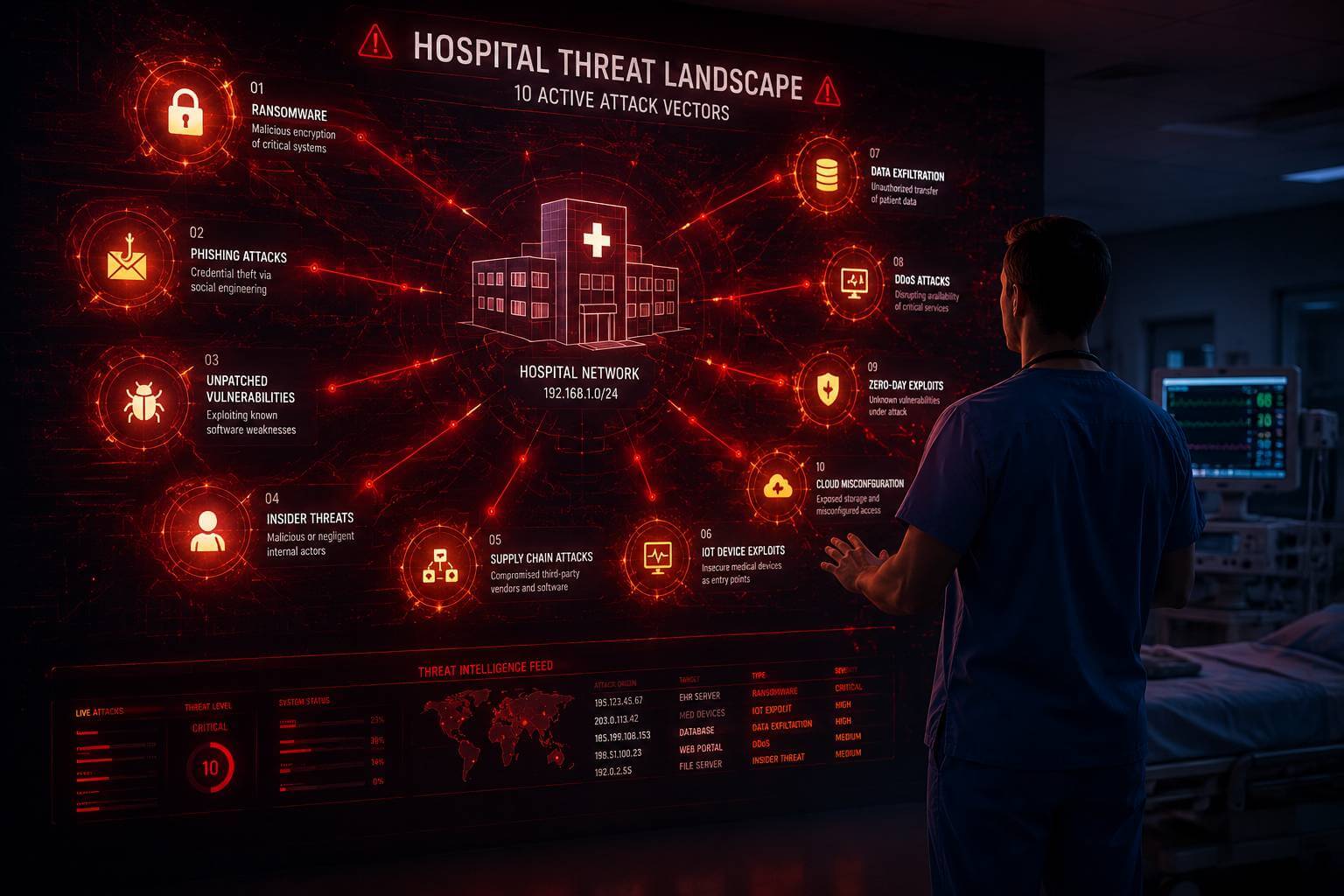
Healthcare remains the most targeted sector for financially motivated cybercriminals, state-sponsored threat actors, and opportunistic attackers alike. The consequences of a successful cyberattack on a healthcare organization extend far beyond the financial and reputational damage that affects organizations in other sectors. Patient care can be delayed or disrupted. Medical devices can be rendered inoperable. Emergency diversions can strain regional healthcare capacity. In the most severe cases, researchers have drawn direct lines between ransomware attacks on hospitals and increased patient mortality during the periods of system unavailability.
Understanding the specific threats facing healthcare organizations today is the first step toward building a security program capable of defending against them. This article examines the ten most significant cybersecurity threats targeting healthcare in 2026, explains why each threat is particularly dangerous in the healthcare context, and describes the controls and frameworks that organizations should prioritize to defend against each one.
1. Ransomware Targeting Clinical Operations
Ransomware remains the dominant threat facing healthcare organizations in 2026, and the tactics used by ransomware groups have evolved significantly beyond simple file encryption. Modern ransomware attacks targeting healthcare follow a multi-stage pattern: initial access through phishing or exposed remote access services, lateral movement across the network to maximize the footprint of the attack, data exfiltration before encryption to enable double extortion, and then deployment of the ransomware payload to encrypt systems and demand payment.
The healthcare-specific danger of ransomware is the operational impact on clinical systems. When EHR systems, clinical imaging platforms, laboratory information systems, and pharmacy management systems are encrypted or taken offline, clinical staff must revert to paper-based workflows that are slower, more error-prone, and less capable of supporting complex care coordination. Elective procedures are cancelled. Emergency patients are diverted to other facilities. Patient safety risk increases materially during every hour that clinical systems remain unavailable.
Ransomware groups have demonstrated a pattern of deliberately targeting healthcare organizations during periods of maximum operational pressure, including flu seasons, holiday periods, and during major public health events, understanding that the combination of high patient volumes and reduced tolerance for operational disruption increases the likelihood of payment.
2. Business Email Compromise and Phishing
Business email compromise (BEC) is consistently one of the highest-dollar-loss threat categories in healthcare, though it receives less attention than ransomware because the losses are financial rather than operational. BEC attacks target accounts payable teams, finance executives, and human resources personnel with convincing impersonation of vendors, executives, or regulatory bodies to redirect payments, obtain sensitive employee information, or authorize fraudulent transactions.
Phishing attacks targeting healthcare staff have become increasingly sophisticated in 2026 due to the availability of AI-powered phishing tools that can generate personalized, contextually relevant lures at scale. Attackers use information harvested from social media, professional networking sites, and previous data breaches to craft phishing emails that reference specific colleagues, departments, patients, or clinical workflows that the target would recognize as legitimate.
Talk to Secure Traces
Need help applying this to your environment?
Our team can translate these ideas into a roadmap, architecture review, or pilot for your organization.
3. Medical Device and IoT Vulnerabilities
Healthcare organizations deploy tens of thousands of networked medical devices including patient monitors, infusion pumps, imaging systems, ventilators, and laboratory analyzers that connect to clinical networks to transmit telemetry, receive software updates, and integrate with EHR systems. The security posture of this device estate is one of the most serious and underaddressed vulnerabilities in healthcare cybersecurity.
Medical devices present unique security challenges that differ from traditional IT endpoints. Many devices run embedded operating systems that cannot be patched or updated without vendor involvement and regulatory approval processes that take months. Devices certified for clinical use under specific software configurations may lose their certification if security patches are applied outside the approved update process. Many devices were designed for clinical functionality without security as a design requirement, and adding security controls retroactively is technically constrained by the device architecture.
4. Third-Party and Supply Chain Attacks
Healthcare organizations rely on extensive ecosystems of third-party vendors for EHR systems, revenue cycle management, medical billing, laboratory services, clinical decision support, and dozens of other functions. Each vendor relationship represents a potential attack vector because attackers who successfully compromise a vendor with trusted access to multiple healthcare client environments can use that access to attack all of those clients simultaneously.
The 2024 Change Healthcare ransomware attack demonstrated the catastrophic potential of supply chain attacks in healthcare at a scale that affected the vast majority of US healthcare providers. A single attack on a payment processing intermediary disrupted claims submission and reimbursement flows for thousands of healthcare organizations simultaneously, causing financial distress that threatened the operational continuity of smaller providers.
HIPAA requires covered entities to execute Business Associate Agreements with vendors that handle protected health information, but a BAA is a contractual instrument, not a security control. Organizations must go beyond BAAs to implement technical access controls that enforce least-privilege access for vendor connections, continuous monitoring of vendor activity on their networks, and documented incident response procedures that address third-party breach scenarios.
5. AI-Powered Attack Techniques
Attackers have adopted AI tools to enhance the effectiveness and scale of attacks against healthcare organizations in 2026, and this trend is accelerating. AI is lowering the skill barrier for conducting sophisticated attacks by automating reconnaissance, generating convincing phishing content, identifying vulnerable targets at scale, and enabling attackers to operate more efficiently across multiple target environments simultaneously.
AI-powered voice cloning and deepfake video capabilities have made vishing attacks significantly more dangerous. Attackers can now generate convincing audio impersonations of executives, vendors, or regulators that can deceive even security-aware employees who know how to verify unusual requests. Healthcare organizations that rely on voice verification for sensitive processes like wire transfer authorization, password resets, or access provisioning are particularly exposed to this attack vector.
6. Insider Threats and Privilege Abuse
Talk to Secure Traces
Need help applying this to your environment?
Our team can translate these ideas into a roadmap, architecture review, or pilot for your organization.
Insider threats represent a category of risk that is particularly elevated in healthcare due to the broad access that clinical and administrative staff require to perform their roles and the high value of patient data for identity theft, insurance fraud, and pharmaceutical diversion schemes. Malicious insiders in healthcare settings may access patient records for identity theft, sell patient data to third parties, facilitate pharmaceutical diversion by manipulating dispensing records, or assist external attackers by providing credentials or disabling security controls.
Negligent insiders, who are employees who create security risk through careless behavior rather than malicious intent, are statistically far more common than malicious insiders but can cause equivalent damage. Sharing credentials, accessing patient data from personal devices on unsecured networks, using weak passwords, falling for phishing attacks, and misconfiguring cloud storage settings are common examples of negligent insider behavior that creates exploitable vulnerabilities.
7. Cloud Misconfiguration and Exposed PHI
Healthcare organizations have accelerated cloud adoption significantly over the past several years, migrating clinical applications, data warehouses, backup repositories, and collaboration tools to cloud platforms. Cloud misconfiguration is consistently one of the leading causes of healthcare data breaches. Public storage buckets containing PHI, misconfigured cloud database permissions exposing patient records without authentication, and improperly secured API endpoints returning patient data to unauthorized callers are all common configuration errors that have resulted in large-scale healthcare data exposures.
The shared responsibility model of cloud security means that cloud platform providers secure the underlying infrastructure while healthcare organizations are responsible for securing what they deploy on that infrastructure. Many healthcare IT teams have not fully internalized this responsibility boundary or developed the cloud security expertise needed to configure complex cloud environments securely.
8. Legacy System Vulnerabilities
Healthcare organizations operate extensive fleets of legacy systems, including operating systems, clinical applications, and medical device software, that cannot be upgraded or patched due to vendor support limitations, clinical certification requirements, or the cost and complexity of replacement. These legacy systems are known to run software versions with documented, publicly disclosed vulnerabilities that attackers can exploit using freely available tools.
Compensating controls are the primary defense strategy for legacy systems that cannot be patched or replaced. Network segmentation that isolates legacy systems from the broader network limits an attacker's ability to reach them and limits the damage they can cause if compromised. Endpoint protection agents compatible with legacy operating systems provide additional detection and blocking capability. Application whitelisting prevents unauthorized code from executing on legacy endpoints even if attackers reach them.
9. Regulatory Non-Compliance as a Risk Multiplier
Regulatory non-compliance with HIPAA Security Rule requirements is both a legal and operational risk for healthcare organizations. Organizations that have not fully implemented the administrative, physical, and technical safeguards required by the HIPAA Security Rule typically have significant security control gaps that create exploitable vulnerabilities while simultaneously creating liability exposure that compounds the financial impact of any breach.
Talk to Secure Traces
Need help applying this to your environment?
Our team can translate these ideas into a roadmap, architecture review, or pilot for your organization.
The HHS Office for Civil Rights has increased the frequency and scope of HIPAA enforcement actions, and recent settlements and civil monetary penalties have reached into the tens of millions of dollars for organizations that experienced breaches while operating with documented security control failures. The combination of breach-related costs with OCR penalties and class action litigation can be financially devastating for smaller and mid-sized healthcare organizations.
10. Agentic AI Security Risks
The deployment of AI agents in healthcare settings in 2026 has introduced a new category of security risk that most healthcare security programs have not yet fully assessed or addressed. AI agents that are integrated with clinical systems, EHR APIs, claims processing workflows, and patient communication channels create new attack surfaces and new failure modes that differ qualitatively from the risks of traditional software systems.
Prompt injection attacks are the most immediate AI-specific threat, where attackers embed malicious instructions in data that AI agents process, such as patient records, incoming claims, or external documents, causing the agent to take unauthorized actions or disclose sensitive information in ways that bypass traditional security controls.
The MCP gateway architecture is the foundational control for governing AI agent access to healthcare systems. An MCP gateway enforces least-privilege access at the agent level, logs all agent actions with an immutable audit trail, applies PHI redaction controls to prevent sensitive data from appearing in AI model outputs, and provides the visibility needed for security teams to detect anomalous agent behavior.
Building a Comprehensive Healthcare Cybersecurity Defense
Addressing the full scope of threats outlined above requires a layered security architecture that combines people, process, and technology controls aligned to established frameworks. The NIST Cybersecurity Framework 2.0, which added a Govern function to the original five functions of Identify, Protect, Detect, Respond, and Recover, provides the most widely used organizational structure for healthcare security programs.
| NIST CSF 2.0 Function | Key Healthcare Actions |
|---|---|
| Identify | Asset inventory, annual security risk assessments, third-party risk management program |
| Protect | MFA for all remote access, network segmentation, least privilege, security awareness training |
| Detect | Managed SOC with 24x7 monitoring, EDR on all endpoints, CSPM for cloud environments |
| Respond | Healthcare-specific incident response playbooks, annual tabletop exercises, pre-established IR vendor relationships |
| Recover | Offline immutable backups, tested restoration procedures, documented clinical downtime procedures |
| Govern | Executive security ownership, HIPAA/HITRUST/NIST CSF 2.0 alignment, board-level risk reporting |
Conclusion
The threat landscape facing healthcare organizations in 2026 is broad, sophisticated, and rapidly evolving. Ransomware groups are refining their double extortion tactics specifically for healthcare operational environments. AI-powered attack tools are enabling more sophisticated phishing, social engineering, and automated exploitation at scales that would have been impossible for human attackers alone. Medical device fleets are expanding faster than security programs can assess and protect them. And the emergence of agentic AI in clinical and administrative workflows is creating new attack surfaces that traditional security controls are not designed to address.
The healthcare organizations that will successfully defend against this threat landscape are those that treat cybersecurity as a strategic operational priority rather than a compliance checkbox. That means building security programs structured around comprehensive frameworks like NIST CSF 2.0 and HITRUST CSF, investing in managed detection and response capabilities that provide continuous monitoring rather than periodic assessments, and building the governance structures that ensure security risk receives appropriate executive and board attention.
About the author
Founder & CEO, Secure Traces
30+ years in enterprise cybersecurity · Former Verint · Former GE
Natraj is the Founder and CEO of Secure Traces with over three decades of experience in enterprise cybersecurity, cloud infrastructure, and IT modernization. He has held senior security and architecture roles at Verint and GE, and advises boards on AI governance, SOC modernization, and cyber-risk strategy.