AI · Compliance
What Is an MCP Gateway and Why It Matters for Agentic AI in Regulated Industries
Learn what an MCP gateway is, how it governs agentic AI connectivity in regulated industries, and why healthcare organizations cannot deploy production AI agents without one.
Secure Traces AI Solutions practice designs and deploys governed agentic AI systems with MCP gateway architecture built in from day one, ensuring regulated industries can operate production AI with full audit trails and PHI guardrails. For healthcare organizations where agents interact with Protected Health Information, the Secure Traces Healthcare and Pharmacy Technology practice ensures AI governance is aligned with HIPAA Security Rule requirements from the ground up.
What most of these organizations have not yet solved is the governance problem. AI agents that can autonomously connect to enterprise systems, read sensitive data, and take actions in production environments are enormously powerful. They are also enormously risky if that connectivity is not controlled, audited, and governed at the architectural level.
The Model Context Protocol gateway is the infrastructure layer that solves this problem. It is the mechanism that determines what AI agents can reach, what they can do, and what record is kept of every action they take. For regulated industries where agents touch Protected Health Information, personally identifiable information, or financial data, an MCP gateway is not an optional enhancement. It is the foundational control that makes production AI deployment possible without creating a compliance and security liability.
This article explains what the Model Context Protocol is, what an MCP gateway does, why it matters specifically for regulated industries, and how to evaluate whether an AI deployment is genuinely governed or just described as governed.
What Is the Model Context Protocol?
The Model Context Protocol, commonly referred to as MCP, is an open standard developed to provide a standardized way for AI agents and large language models to connect to external tools, data sources, and enterprise systems. Before MCP, every integration between an AI agent and an external system required custom, point-to-point connector development. This approach was slow to build, difficult to audit, and impossible to govern at scale as the number of agents and connected systems grew.
MCP defines a common protocol that describes how an AI agent discovers what tools and data sources are available, how it requests access to them, how it formats and sends queries or action requests, and how it receives and processes responses. Systems that expose an MCP-compatible interface can be accessed by any MCP-compatible AI agent without requiring custom integration code for each new connection.
Think of MCP as analogous to what USB did for hardware peripherals. Before USB, every device required its own proprietary connector and driver. After USB, any device and any computer that supported the standard could communicate without custom hardware. MCP does the same thing for AI agent connectivity, creating a standardized interface that dramatically reduces the engineering overhead of connecting agents to enterprise systems.
The standard has been adopted across the AI ecosystem. Leading AI providers including Anthropic, the developer of Claude, have built native MCP support into their models. Enterprise software vendors are building MCP-compatible interfaces into their platforms. And AI orchestration frameworks including LangChain and LangGraph support MCP as a native connectivity layer.
What Is an MCP Gateway?
An MCP gateway is a controlled, governed infrastructure layer that sits between AI agents and the enterprise tools and data sources they need to access. Rather than allowing AI agents to connect directly to any system that exposes an MCP interface, the gateway enforces access policies, applies security controls, and maintains an immutable audit trail of every connection, query, and action that passes through it.
The distinction between an AI agent connecting directly to enterprise systems via MCP and an AI agent connecting through a governed MCP gateway is the difference between an intern with unrestricted access to every system in the building and an employee whose system access is provisioned based on their role, monitored by a security team, and logged with a complete record of every action they take.
Direct MCP connectivity without a gateway gives an AI agent the technical ability to reach any system it has credentials for, read any data those systems contain, and take any action those systems permit. There are no policy controls enforcing least privilege, no PHI or PII guardrails preventing sensitive data from being exposed to the model, and no audit trail recording what the agent actually did beyond whatever the underlying systems log natively.
A governed MCP gateway changes this fundamentally. Every tool and data source that an AI agent can access must be explicitly registered and permitted in the gateway configuration. Role-based access controls define which agents can access which tools and which data. PHI and PII detection and redaction controls are applied to data passing through the gateway before it reaches the AI model. Prompt injection defenses prevent malicious inputs from hijacking agent behavior. And every prompt, retrieved context, tool call, and output is logged with full immutability to an audit trail that can be reviewed by compliance teams, security operations, and regulators.
Why Regulated Industries Cannot Deploy AI Agents Without an MCP Gateway
The governance gap between direct MCP connectivity and gateway-governed connectivity is significant for any enterprise. For regulated industries, it is the difference between a compliant AI deployment and a compliance liability that could trigger regulatory investigation, PHI breach notification obligations, or financial penalties.
Talk to Secure Traces
Need help applying this to your environment?
Our team can translate these ideas into a roadmap, architecture review, or pilot for your organization.
Healthcare and HIPAA. Healthcare organizations deploying AI agents in clinical or administrative environments are almost certainly operating in environments where the agents will interact with Protected Health Information. Under HIPAA, any system that creates, receives, maintains, or transmits PHI is subject to the full requirements of the Security Rule, including access controls, audit controls, integrity controls, and transmission security.
An AI agent that accesses EHR data, processes claims information, or reads clinical documentation without a governed MCP gateway controlling that access cannot demonstrate compliance with HIPAA access control requirements. It cannot produce the audit log that the Security Rule requires for all ePHI interactions. And it cannot demonstrate that PHI was protected from unauthorized exposure to the AI model or to any logging or monitoring system that captures agent activity.
An MCP gateway resolves all three of these gaps. Access controls are enforced at the gateway layer, restricting agent access to only the tools and data explicitly permitted for each agent role. Every ePHI interaction is captured in the gateway audit log with user identity, timestamp, action performed, and data accessed. And PHI redaction controls applied at the gateway prevent sensitive identifiers from reaching the model or appearing in logs in unredacted form.
Insurance and NAIC AI requirements. The National Association of Insurance Commissioners Model Bulletin on the Use of AI Systems by Insurers establishes expectations for governance, accountability, and explainability of AI systems used in insurance underwriting, claims, and customer-facing decisions. AI agents making or supporting decisions that affect policyholders must be governed in a way that allows the organization to explain what data the agent accessed, what reasoning it applied, and what action it took or recommended.
An MCP gateway with immutable audit logging of all agent tool calls and outputs is the infrastructure that makes this level of explainability possible. Without it, the organization has an AI system making consequential decisions with no reliable record of what information drove those decisions.
Financial services and audit requirements. Financial services organizations deploying AI agents in underwriting, fraud detection, regulatory reporting, or customer service contexts face audit requirements that demand complete records of system actions affecting financial data or customer information. An AI agent operating without gateway governance cannot produce the documentation that internal and external auditors require.
EU AI Act high-risk classification. The EU AI Act classifies AI systems used in healthcare, financial services, and other regulated sectors as high-risk systems subject to enhanced transparency, documentation, and governance requirements. High-risk AI systems must maintain technical documentation, event logs, and human oversight mechanisms that allow competent authorities to verify compliance. An MCP gateway with immutable audit logging is a core component of the technical infrastructure required to satisfy these requirements.
Core Functions of an Enterprise MCP Gateway
A production-grade MCP gateway for regulated industry deployment must deliver a specific set of capabilities to satisfy both the operational requirements of AI agent systems and the compliance requirements of regulated environments.
Tool and data source registry. The gateway maintains a registry of all tools and data sources that AI agents are permitted to access. Registering a new connection requires explicit configuration and approval rather than automatic discovery. This means that shadow AI connectivity, where agents access systems that IT and compliance teams are not aware of, is architecturally prevented.
Role-based access control at the tool level. Different AI agents have different roles and therefore different access requirements. A claims processing agent needs access to claims databases and payer APIs but has no legitimate need for access to HR systems or financial reporting platforms. The MCP gateway enforces role-based access controls that restrict each agent to only the tools and data sources appropriate for its defined function, applying the least privilege principle to AI systems exactly as it is applied to human users.
PHI and PII detection and redaction. Data retrieved from enterprise systems and passed to AI models may contain Protected Health Information, personally identifiable information, or other sensitive data categories that must be handled with specific controls. The MCP gateway applies automated PHI and PII detection using platforms such as Presidio and Nightfall to identify sensitive data elements in retrieved context and apply appropriate redaction or masking before that data reaches the AI model or appears in logs.
Prompt injection defense. Prompt injection is an attack technique where malicious content embedded in data sources attempts to override AI agent instructions and redirect the agent toward unauthorized actions. A governed MCP gateway applies input validation and prompt injection filters to data entering the agent context, preventing external content from hijacking agent behavior.
Immutable audit logging. Every interaction that passes through the MCP gateway is logged with complete fidelity: the identity of the agent and the user or system that invoked it, the timestamp of the request, the tool or data source accessed, the parameters of the request, and the response returned. These logs are written to an immutable store that prevents modification or deletion by administrators, AI agents, or application systems. The resulting audit trail provides the complete, tamper-proof record of agent activity that HIPAA, NAIC, and other regulatory frameworks require.
Human-in-the-loop controls. For AI agent actions that carry significant consequences, particularly actions that modify data, initiate financial transactions, or make patient care recommendations, the gateway can route approval requests to human reviewers before the action is executed. Human-in-the-loop controls allow organizations to define which agent actions require human approval, ensuring that autonomy is bounded by governance rather than unlimited.
DLP integration. Data Loss Prevention integration at the gateway layer prevents AI agents from exfiltrating sensitive data through output channels that are not authorized for the data classification level of the content being processed. This is particularly important in healthcare and financial services contexts where PHI or financial data must not be transmitted to external systems without appropriate controls.
Talk to Secure Traces
Need help applying this to your environment?
Our team can translate these ideas into a roadmap, architecture review, or pilot for your organization.
The Architecture of a Governed Agentic AI System
Understanding how an MCP gateway fits into the broader architecture of a governed agentic AI system helps clarify why it is a foundational component rather than an optional add-on.
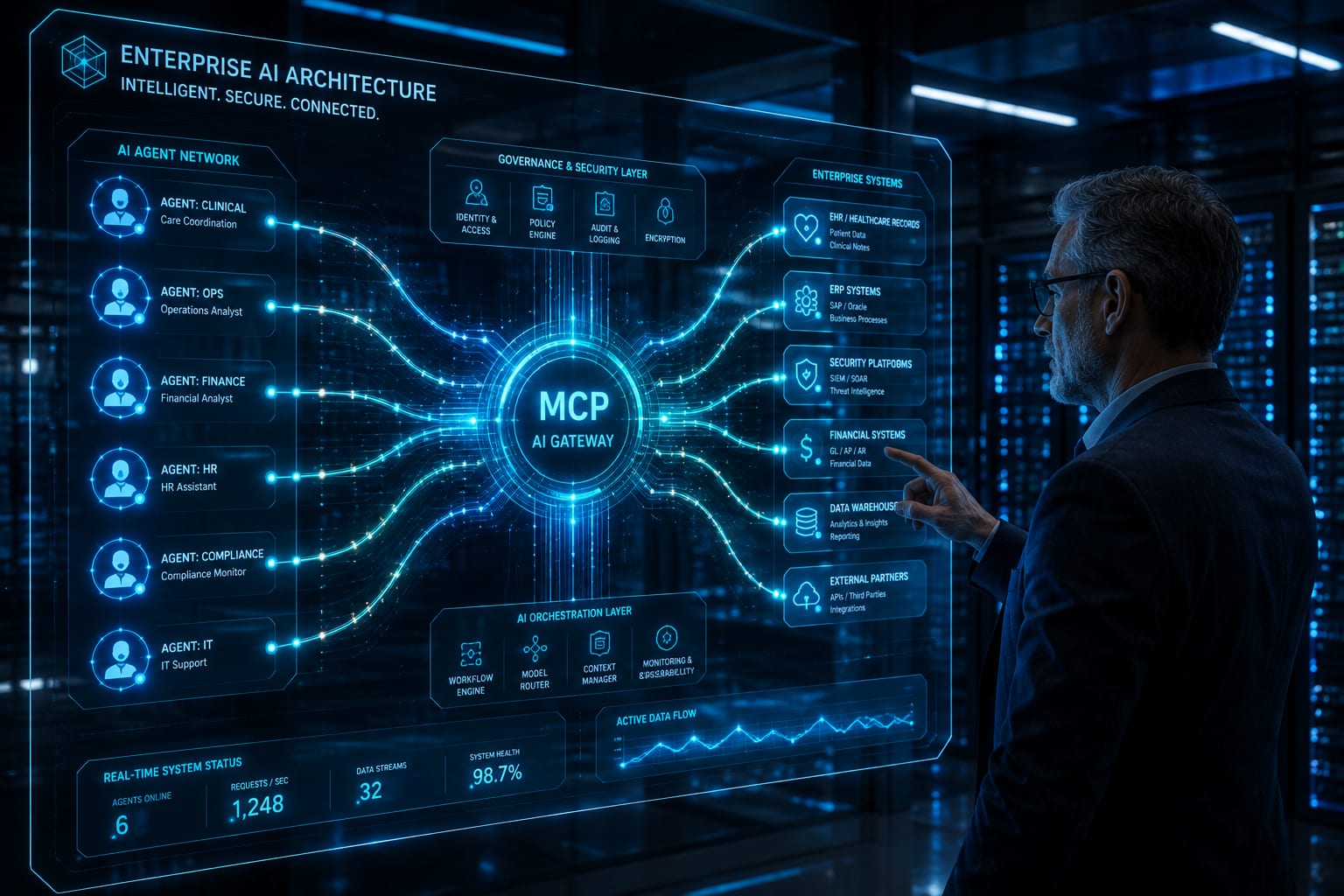
A production agentic AI system consists of several layers working together. The foundation layer is the large language model or models that provide reasoning and language generation capability. Above that is the agent orchestration layer, which manages multi-step task execution, tool selection, and context management across the agent workflow. The MCP gateway sits between the agent orchestration layer and the enterprise systems layer, controlling and auditing every connection the agents make to production data and tools. The enterprise systems layer contains the EHR platforms, claims databases, security tools, ERP systems, and other production systems that agents need to access to do their work. And the governance layer sits above everything, providing the policy configuration, audit log access, and human oversight interfaces that compliance and security teams use to monitor and control the AI environment.
In a system without an MCP gateway, the agent orchestration layer connects directly to the enterprise systems layer without any intermediary control or audit point. Governance exists only at the agent configuration level, which means that if the agent behaves unexpectedly, or if a prompt injection attack succeeds, there is no architectural barrier preventing the agent from accessing systems or data beyond its intended scope.
In a governed system with an MCP gateway, every connection from the agent orchestration layer to the enterprise systems layer passes through a controlled chokepoint where access policy is enforced, sensitive data is protected, and every action is recorded. Unexpected agent behavior triggers audit log entries that security operations can detect and investigate. Prompt injection attacks are filtered before they reach the agent context. And the complete record of agent activity is available for compliance review at any time.
Chatbot vs RAG Assistant vs Governed Agentic AI
Many organizations use the terms chatbot, AI assistant, and agentic AI interchangeably, but they describe fundamentally different architectures with fundamentally different compliance implications.
A chatbot responds to user inputs using a predefined knowledge base or scripted response logic. It does not access live enterprise data, does not execute actions in production systems, and does not require an MCP gateway because it has no enterprise connectivity.
A Retrieval Augmented Generation assistant retrieves information from a knowledge base or document repository to ground its responses in current data rather than relying solely on model training. RAG assistants occasionally execute simple actions but do not typically operate multi-step workflows or access multiple enterprise systems autonomously. They require some governance controls but operate in a more limited action space than agentic AI.
A governed agentic AI system executes complex, multi-step workflows autonomously, accessing multiple enterprise systems, retrieving data, applying reasoning, and taking actions with real consequences in production environments. This is the architecture that delivers the most significant business value, and it is also the architecture that requires MCP gateway governance to be deployable in regulated environments.
For healthcare organizations using agentic AI for claims processing, the agent might retrieve patient eligibility data from a payer API, read the clinical documentation from the EHR, validate the claim against payer rules, identify a potential denial risk, and route the claim to a human reviewer before submission. Every one of those steps involves accessing a different enterprise system with different data classifications, and every one of those steps must be governed and audited.
Without an MCP gateway, none of those steps have a governed access control or an auditable record. With an MCP gateway, every step is controlled by access policy, every data retrieval is screened for PHI, and the complete sequence of agent actions is captured in an immutable audit log that satisfies HIPAA Security Rule audit control requirements.
How Secure Traces Designs and Deploys MCP Gateways
Secure Traces delivers MCP gateway design, deployment, and policy authoring as a core component of every agentic AI engagement through the AI Solutions and Agentic Automation practice. The gateway deployment is not treated as a peripheral compliance checkbox but as the foundational architectural decision that determines whether a production AI system is deployable in a regulated environment.
The MCP gateway deployment process begins during the build phase of the Secure Traces AI engagement, in weeks four through fourteen, following the assessment phase where use cases, data sources, access requirements, and compliance scope are defined. The gateway reference architecture is designed around the specific tool and data source access requirements of the first production agent, with policy configuration that enforces least privilege access, PHI and PII redaction controls calibrated to the data classifications present in the environment, and audit logging configured to capture the specific fields required by the applicable regulatory frameworks.
PHI and PII guardrails are implemented using Presidio and Nightfall, which are the detection and redaction platforms that Secure Traces uses as standard components of healthcare AI deployments. Prompt injection filters are configured based on the specific attack vectors most relevant to the agent use case and data environment. Human-in-the-loop approval routing is configured for actions above defined consequence thresholds.
Talk to Secure Traces
Need help applying this to your environment?
Our team can translate these ideas into a roadmap, architecture review, or pilot for your organization.
The ongoing scale and govern phase extends the gateway configuration as additional agents and use cases are added to the roadmap, with quarterly red team exercises specifically targeting the gateway and its controls, and policy reviews conducted at least annually to ensure that the gateway configuration remains aligned with current regulatory requirements and threat intelligence.
For healthcare organizations deploying agentic AI in clinical or administrative environments, the MCP gateway is integrated with the Healthcare and Pharmacy Technology practice, ensuring that the AI governance architecture is aligned with HIPAA Security Rule requirements, HITRUST CSF controls, and the specific data handling requirements of EHR and claims system integrations.
For organizations that need security operations coverage across the AI environment, the Cybersecurity services practice provides 24x7 SOC monitoring that includes AI agent activity in its detection scope, with behavioral analytics capable of identifying anomalous agent behavior that may indicate a prompt injection attack or an unauthorized access attempt.
Questions to Ask Before Deploying Agentic AI in a Regulated Environment
For CIOs, CISOs, and compliance officers evaluating agentic AI proposals from internal teams or external vendors, these questions determine whether a proposed deployment is genuinely governed or simply described as such.
Is there a governed MCP gateway or direct connectivity? Ask specifically whether the AI agent connectivity passes through a governed gateway with enforced access controls or whether agents connect directly to enterprise systems. Direct connectivity without a gateway is not compliant governance regardless of how it is described.
What access controls govern which agents can access which tools and data? Verify that access controls exist at the tool and data source level, not just at the agent configuration level. Role-based access control at the gateway layer is the required standard.
What PHI and PII controls are applied? Ask specifically what technology is used to detect and redact sensitive data before it reaches the AI model, and verify that those controls are applied at the gateway layer rather than relying on the AI model to handle sensitive data appropriately.
What does the audit log capture? Request a sample audit log entry and verify that it captures the agent identity, timestamp, tool accessed, request parameters, and response with sufficient detail to satisfy regulatory audit requirements.
Where are audit logs stored and can they be modified? Audit logs must be stored in an immutable format that prevents modification by system administrators, AI agents, or application systems. Logs stored in standard databases without immutability controls do not satisfy regulatory requirements.
Has the gateway been red-teamed for prompt injection? Prompt injection attacks against AI agents in production environments are a real and documented threat. A governance program that has not specifically tested the gateway against prompt injection attacks has an unknown security posture for one of the most significant attack vectors in agentic AI.
Conclusion
The MCP gateway is the governance infrastructure that determines whether agentic AI is safe to deploy in regulated industries. It is the architectural layer that enforces access policy, protects sensitive data, defends against prompt injection, and produces the immutable audit trail that healthcare, financial services, and insurance organizations need to demonstrate compliance with HIPAA, NAIC, EU AI Act, and other regulatory frameworks.
Organizations that deploy agentic AI without a governed MCP gateway are not operating ungoverned AI by choice. They are typically operating ungoverned AI because their vendor or internal team did not build governance into the architecture from the beginning, and retrofitting governance onto an ungoverned system is significantly more difficult and expensive than building it in from the start.
Secure Traces designs and deploys production agentic AI systems with MCP gateway governance built into the reference architecture from day one. Every agent that Secure Traces builds passes through a gateway that enforces access policy, protects PHI and PII, defends against prompt injection, and logs every action with full immutability. The result is an AI system that delivers the operational benefits of autonomous agent capability while satisfying the governance, auditability, and compliance requirements that regulated industries demand.
To learn how Secure Traces can design and deploy a governed agentic AI program for your organization, contact Secure Traces to schedule a consultation.
About the author
Founder & CEO, Secure Traces
30+ years in enterprise cybersecurity · Former Verint · Former GE
Natraj is the Founder and CEO of Secure Traces with over three decades of experience in enterprise cybersecurity, cloud infrastructure, and IT modernization. He has held senior security and architecture roles at Verint and GE, and advises boards on AI governance, SOC modernization, and cyber-risk strategy.