
Cybersecurity · Healthcare
What Is HITRUST CSF and How Does It Apply to Healthcare Cybersecurity Programs
Learn what the HITRUST CSF is, how it maps to HIPAA and other healthcare regulations, what the certification process involves, and why it is the gold standard framework for healthcare cybersecurity program development and third-party risk management.
The Secure Traces Cybersecurity practice supports HITRUST CSF program development as a standard component of its healthcare security engagements, providing gap assessment, remediation planning, policy development, and External Assessor coordination. The Secure Traces Healthcare and Pharmacy Technology practice brings deep expertise in the HIPAA-to-HITRUST mapping for healthcare pharmacy, revenue cycle, and clinical data environments.
The HIPAA Security Rule establishes the baseline obligation for protecting electronic protected health information, but it is deliberately technology-neutral and non-prescriptive about how its required safeguards must be implemented, leaving healthcare organizations to determine on their own how to implement controls that satisfy the rule. HIPAA auditors and enforcement actions have repeatedly found that many organizations interpret this flexibility as permission for minimal control implementation, creating security programs that satisfy the letter of the rule without meaningfully reducing risk.
Beyond HIPAA, healthcare organizations must also satisfy requirements from HITECH, state privacy laws, CMS Conditions of Participation, the 21st Century Cures Act, FDA cybersecurity guidance for medical devices, PCI DSS if they process payment card data, and an expanding set of state-level data breach notification and data protection laws. Each of these regulatory frameworks uses different terminology, different control categories, and different assessment methodologies, creating a compliance management challenge that consumes enormous staff time and consulting resources at every healthcare organization that faces the full scope of these requirements simultaneously.
The HITRUST CSF was created specifically to address this challenge. It provides a single, comprehensive, prescriptive control framework that incorporates the requirements of HIPAA, HITECH, NIST, ISO 27001, PCI DSS, CMS, and more than two dozen other authoritative sources into one unified control set with a structured assessment and certification program. For healthcare organizations, HITRUST CSF certification has become the most widely recognized and rigorously validated demonstration of security program maturity, and for healthcare business partners and vendors, HITRUST certification has become a standard due diligence requirement in procurement and contracting processes.
This article explains what the HITRUST CSF is, how its control structure works, what the different certification levels mean, how the framework maps to HIPAA and other healthcare regulatory requirements, and how healthcare organizations should approach building a HITRUST-aligned security program.
What Is the HITRUST CSF?
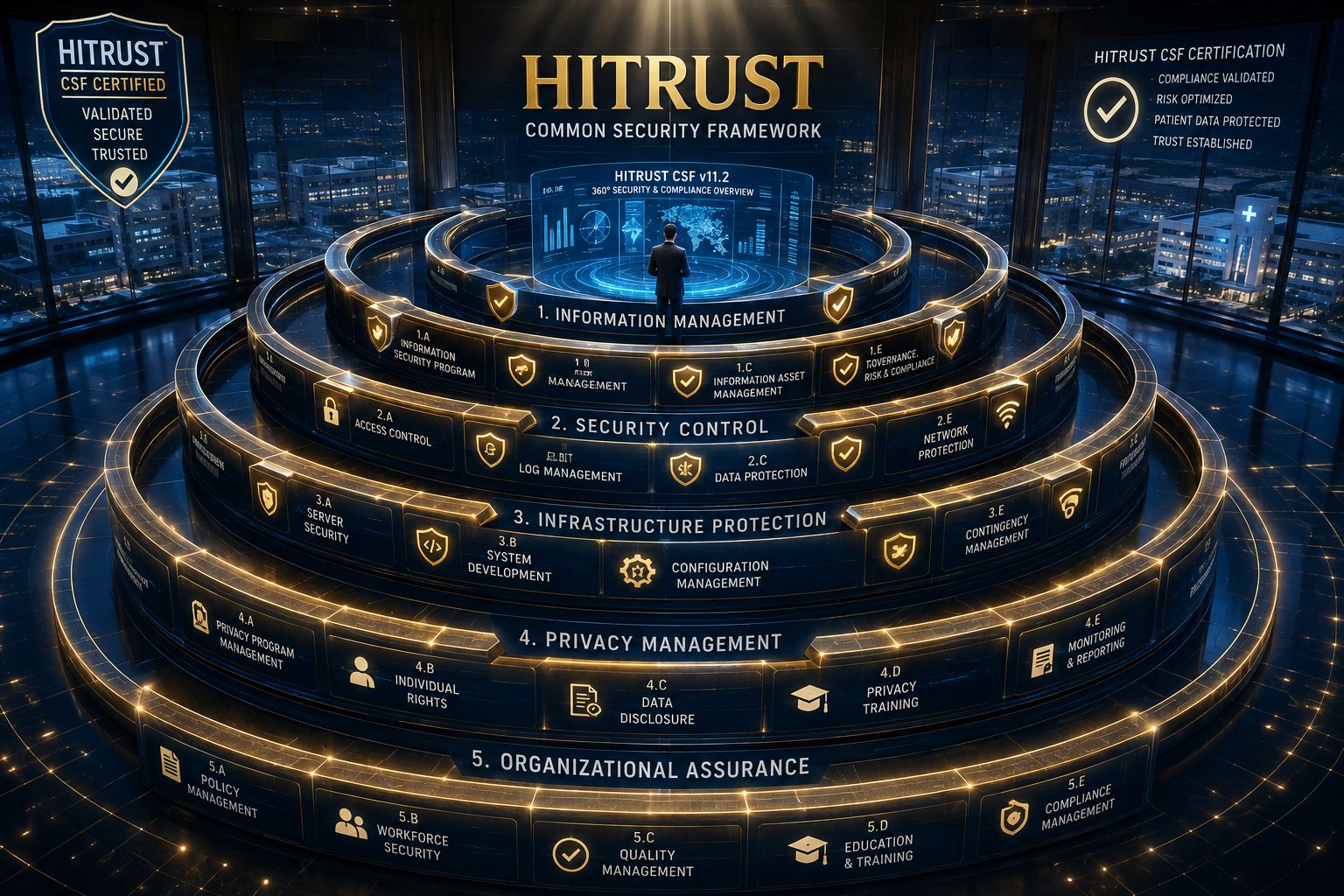
The HITRUST Common Security Framework, known as the HITRUST CSF, is a certifiable framework developed and maintained by the Health Information Trust Alliance, known as HITRUST. HITRUST is a private organization founded in 2007 with the specific mission of developing a comprehensive, scalable, and certifiable security and privacy framework for the healthcare industry.
The CSF is described as a common security framework because it is designed to serve as the common language and common control set across the diverse ecosystem of healthcare organizations, health plans, healthcare technology companies, business associates, and government agencies that exchange sensitive health information. Rather than having each organization develop its own interpretation of HIPAA requirements and each business partner audit that interpretation separately, HITRUST provides a shared framework with a standardized assessment methodology and a certifiable output that all parties can rely on.
The framework is organized into 19 control domains, which are broad categories of security and privacy capability, and within those domains defines a library of specific control requirements. As of HITRUST CSF version 11, which is the current version, the framework contains over 2,000 requirement statements drawn from more than 50 authoritative sources including HIPAA, NIST SP 800-53, ISO/IEC 27001 and 27002, PCI DSS, CMS ARS, COBIT, FedRAMP, and GDPR.
The 19 HITRUST CSF control domains cover the full scope of information security and privacy program requirements: Information Security Management Program, Access Control, Human Resources Security, Risk Management, Security Policy, Organization of Information Security, Compliance, Asset Management, Physical and Environmental Security, Configuration Management, Vulnerability Management, Incident Management, Business Continuity Management, Network Protection, Transmission Protection, Password Management, Audit Logging and Monitoring, Education Training and Awareness, and Information Privacy.
How the HITRUST CSF Control Structure Works
Understanding how HITRUST CSF controls are structured helps explain both the comprehensiveness of the framework and the scalability mechanism that allows it to be applied appropriately to organizations of very different sizes, complexity levels, and risk profiles.
Control requirements and implementation levels. Each control requirement in the HITRUST CSF is defined at one or more implementation levels. Implementation Level 1 is the baseline requirement that applies to all organizations regardless of size or risk profile. Implementation Level 2 adds additional requirements for organizations with greater complexity, data volumes, or risk exposure. Implementation Level 3 represents the most rigorous implementation and applies to organizations with the highest risk profiles, including large health plans, academic medical centers, and healthcare technology companies that process PHI at massive scale.
Talk to Secure Traces
Need help applying this to your environment?
Our team can translate these ideas into a roadmap, architecture review, or pilot for your organization.
This tiered implementation structure means that a small medical practice with limited IT infrastructure and a regional health system with thousands of employees and complex technology environments both have a relevant path to HITRUST compliance, with the level of control implementation calibrated to their actual risk profile rather than applying a uniform set of requirements regardless of organizational characteristics.
Tailoring factors. The HITRUST CSF uses a set of tailoring factors to determine which control requirements at which implementation levels apply to a specific organization. These factors include organizational size measured by number of employees and locations, regulatory requirements applicable to the organization, types of data stored and processed including PHI, PII, and payment card data, types of systems in scope including cloud, on-premises, and hybrid deployments, and the results of the organization risk assessment. The combination of tailoring factors determines the specific requirement statements that constitute the organization HITRUST assessment scope.
Illustrative procedures. For each requirement statement, the HITRUST CSF provides illustrative procedures that describe specific activities and controls that, if implemented, would satisfy the requirement. These illustrative procedures are guidance rather than mandates, recognizing that different technologies and architectures may satisfy the same security objective in different ways. However, they provide practical implementation guidance that is valuable for organizations building controls to satisfy requirements for the first time.
HITRUST Certification Levels: e1, i1, and r2
HITRUST offers three distinct certification pathways that differ in scope, rigor, and the assurance level they provide to relying parties.
e1 Certification: Essential, One-Year. The e1 assessment is a streamlined certification pathway covering a focused set of 44 requirement statements representing the most critical cybersecurity controls. The e1 was introduced to provide a faster, lower-cost entry point to HITRUST certification for organizations that need to demonstrate foundational security assurance to business partners but are not yet ready for the more comprehensive i1 or r2 assessments. The e1 is validated by a HITRUST External Assessor and produces a one-year certification. It is best suited for smaller organizations or specific system scopes where a comprehensive assessment is not yet practical.
i1 Certification: Implemented, One-Year. The i1 assessment covers approximately 182 requirement statements representing a substantial cross-section of HITRUST CSF controls, with a focus on the specific controls that address the current threat landscape as determined by HITRUST threat intelligence analysis. The i1 requirement set changes annually to reflect evolving threats, making i1 certification a current-state assessment of the specific controls most relevant to active threats rather than a comprehensive framework assessment. The i1 is validated by a HITRUST External Assessor and produces a one-year certification. It is appropriate for organizations that need to demonstrate meaningful security program maturity to business partners and want a faster assessment cycle than the r2 provides.
r2 Certification: Risk-Based, Two-Year. The r2 is the comprehensive HITRUST CSF certification that has historically been the gold standard for healthcare security assurance. An r2 assessment covers the full tailored set of requirement statements applicable to the organization based on its tailoring factors, which typically ranges from several hundred to over a thousand requirement statements for complex healthcare organizations. The r2 is validated by a HITRUST External Assessor through a rigorous process that includes documentation review, system testing, interviews, and on-site assessment activities. The r2 produces a two-year certification with an interim one-year assessment to validate continued compliance. The r2 is the certification level required by most major health plans, healthcare systems, and government agencies when they require HITRUST certification from business associates and technology vendors.
How HITRUST CSF Maps to HIPAA Security Rule Requirements
One of the most valuable characteristics of the HITRUST CSF for healthcare organizations is its explicit mapping to HIPAA Security Rule requirements, which allows organizations to use HITRUST program activities to satisfy HIPAA compliance obligations rather than managing HIPAA compliance as a separate program track.
The HIPAA Security Rule organizes its requirements into three categories of safeguards: administrative safeguards covering security management, workforce security, information access management, security awareness training, security incident procedures, contingency planning, and evaluation; physical safeguards covering facility access controls, workstation security, and device and media controls; and technical safeguards covering access controls, audit controls, integrity controls, and transmission security.
Each of these HIPAA requirement areas maps to one or more HITRUST CSF control domains, and each specific HIPAA Security Rule standard and implementation specification maps to specific HITRUST requirement statements. Organizations that achieve HITRUST r2 certification against a scope that covers their PHI processing environment have, by definition, implemented controls that satisfy the HIPAA Security Rule requirements within that scope, because the HITRUST requirement set incorporates HIPAA as an authoritative source.
This mapping creates a significant efficiency benefit: rather than maintaining separate programs and documentation for HIPAA compliance and HITRUST compliance, organizations can maintain a single unified control framework and assessment program that satisfies both simultaneously. The HITRUST assessment documentation, control evidence, and certified status can be used directly in HIPAA audit responses and regulatory inquiries, eliminating the duplicated effort of maintaining parallel compliance programs.
Beyond HIPAA, HITRUST CSF also maps to HITECH requirements for breach notification and enhanced enforcement, CMS ARS security requirements for organizations receiving Medicare and Medicaid reimbursement, and state-level data protection requirements in states with specific healthcare data security laws. This multi-framework coverage is the core value proposition of HITRUST for healthcare organizations operating in a complex regulatory environment.
Talk to Secure Traces
Need help applying this to your environment?
Our team can translate these ideas into a roadmap, architecture review, or pilot for your organization.
The Secure Traces Healthcare and Pharmacy Technology practice supports HITRUST-aligned HIPAA Security Rule compliance assessment and program development, leveraging the HITRUST-to-HIPAA mapping to build compliance programs that address both regulatory frameworks through a unified control implementation and assessment approach.
The HITRUST Assessment and Certification Process
Understanding what the HITRUST certification process involves is essential for healthcare organizations planning their first assessment or managing existing certifications. The process involves multiple parties, defined phases, and specific documentation and evidence requirements that organizations must prepare for.
Scoping. The first step in any HITRUST assessment is defining the assessment scope, which specifies the organizational units, systems, processes, and physical locations that will be included in the assessment. Scope definition has significant implications for both the cost and the credibility of the certification, because a narrowly scoped certification may not satisfy relying party requirements that expect the certification to cover the full environment in which PHI is processed.
Tailoring and requirement identification. Once the scope is defined, the HITRUST tailoring factors are applied to identify the specific requirement statements that constitute the assessment. For an r2 assessment, this process produces the list of requirements that the organization must demonstrate it has implemented, and this list drives the gap assessment, remediation planning, and assessment evidence collection activities.
Gap assessment. Before the formal certification assessment begins, most organizations conduct an internal or consultant-assisted gap assessment that evaluates current control implementation against each applicable requirement statement. The gap assessment identifies requirements that are not currently met and produces a remediation roadmap for bringing those controls into compliance before the formal certification assessment.
Remediation. The remediation phase implements the controls and processes needed to close the gaps identified in the gap assessment. Remediation timelines vary significantly based on the number and complexity of gaps, but organizations should plan for several months of remediation work between the gap assessment and the formal certification assessment for a first-time r2 assessment.
Validated assessment by External Assessor. HITRUST certifications must be conducted by a HITRUST-authorized External Assessor organization rather than by the organization itself. The External Assessor conducts the validated assessment by reviewing documentation, interviewing control owners, testing control implementation, and scoring each requirement statement on a defined maturity scale. The assessor submits the validated results to HITRUST for quality review and final certification determination.
Certification. HITRUST reviews the External Assessor submission and either grants certification, requests additional evidence for specific requirements, or denies certification if the control implementation does not meet the required threshold. Certified organizations receive a HITRUST certification letter and are listed in the HITRUST CSF Assessments Registry, which relying parties can use to verify certification status.
The Secure Traces Cybersecurity practice supports HITRUST assessment preparation through gap assessment services, remediation planning and implementation support, policy and procedure documentation development, control evidence preparation, and coordination with the External Assessor throughout the validated assessment process.
HITRUST for Business Associate and Third-Party Risk Management
One of the most practically significant applications of HITRUST CSF in healthcare is its use as the standard for third-party risk management and business associate security assessment. Healthcare covered entities that share PHI with business associates are required by HIPAA to obtain satisfactory assurances that business associates will protect the PHI appropriately, and HITRUST certification has emerged as the most widely accepted mechanism for providing those assurances.
A business associate or healthcare technology vendor that holds a current HITRUST r2 certification can provide that certification to covered entity customers as evidence of security program maturity without requiring each customer to conduct its own independent security assessment. The HITRUST certification, validated by a HITRUST-authorized External Assessor and reviewed by HITRUST, provides a level of assurance that typical vendor security questionnaire responses and point-in-time penetration test reports cannot match.
For healthcare technology companies, cloud service providers, healthcare IT managed services organizations, and other businesses that serve healthcare covered entities as business associates, HITRUST r2 certification has become a competitive differentiator and a procurement prerequisite for serving the largest healthcare organizations. Major health plans and large health systems increasingly require HITRUST r2 certification as a condition of doing business rather than accepting alternative security documentation.
Talk to Secure Traces
Need help applying this to your environment?
Our team can translate these ideas into a roadmap, architecture review, or pilot for your organization.
For covered entities on the relying party side, HITRUST certification from business associates reduces the burden of third-party security assessment. Rather than maintaining large internal teams to conduct detailed security assessments of every business associate, organizations can accept HITRUST certification as satisfying their due diligence requirement and focus their assessment resources on vendors that do not hold certifications and on reviewing the specific scope and any corrective action plans associated with existing certifications.
Building a HITRUST-Aligned Security Program: Practical Guidance
Healthcare organizations that have decided to pursue HITRUST certification or align their security programs to the CSF framework should approach the program build with a structured methodology that sets realistic timelines and builds sustainable program infrastructure.
Start with the right scope. Scope decisions made at the beginning of the program have long-lasting implications. Define the assessment scope to cover the systems and environments where PHI is actually processed, and be deliberate about whether to include cloud environments, third-party hosted systems, and remote access infrastructure within the scope. An overly narrow scope that excludes critical PHI processing environments will not satisfy relying party requirements, while an overly broad scope will increase assessment cost and complexity without corresponding benefit.
Build policy infrastructure first. HITRUST CSF assessments evaluate both the existence of documented policies and procedures and the implementation of the controls they prescribe. Organizations that try to implement technical controls without the underlying policy documentation will fail documentation-based requirements even if their technical controls are strong. Building the policy and procedure library that covers each HITRUST control domain is a foundational early step.
Invest in evidence management. HITRUST assessments are evidence intensive. For each requirement statement, the External Assessor will request documentation, system configuration screenshots, log samples, training records, test results, and other evidence that demonstrates the control is implemented and operating effectively. Organizations that do not have systematic evidence collection processes in place before the assessment begins will find the evidence collection phase extremely burdensome. Building a continuous evidence collection workflow that gathers and organizes assessment evidence throughout the year rather than scrambling to collect it in the weeks before the assessment dramatically reduces assessment friction.
Plan for the two-year cycle. An r2 certification is a two-year certification with an interim one-year assessment. Organizations should plan their program activities on the two-year certification cycle, conducting internal reviews and control testing at regular intervals throughout the cycle rather than treating the certification as a point-in-time project. Controls that pass the initial certification assessment but are not maintained will fail the interim assessment.
Engage expert support. First-time HITRUST r2 assessments are complex undertakings that benefit significantly from experienced guidance. Organizations that attempt their first HITRUST assessment without experienced support frequently underestimate the gap between their current control implementation and the HITRUST requirement level, leading to extended remediation timelines and delayed certification. Engaging a partner with direct HITRUST assessment experience accelerates the gap assessment, focuses remediation effort on the right priorities, and reduces the risk of unexpected findings in the validated assessment.
The Secure Traces Cybersecurity practice provides end-to-end HITRUST program support for healthcare organizations, including initial gap assessment, remediation planning and implementation, policy and procedure development, evidence management support, and coordination throughout the validated assessment process. The practice delivers security programs aligned to HITRUST CSF v11 as a standard component of its healthcare security engagements, recognizing that HITRUST alignment simultaneously satisfies HIPAA Security Rule requirements, NIST CSF 2.0 alignment, and the third-party assurance requirements of major health plan and health system customers.
To learn how Secure Traces can support your organization HITRUST certification journey, contact Secure Traces to schedule a HITRUST gap assessment consultation.
Conclusion
The HITRUST CSF has earned its position as the most widely recognized security and privacy framework in healthcare because it solves a genuine and persistent problem: how to demonstrate credible, independently validated security program maturity in a regulatory environment that offers flexible requirements but imposes severe penalties for inadequate implementation.
For healthcare covered entities, HITRUST provides a structured path from a flexible regulatory requirement to a defined, implemented, and certified security program. For business associates and healthcare technology vendors, HITRUST certification provides a universally accepted mechanism for demonstrating security maturity to customer organizations without enduring repeated bilateral security assessments from each new customer.
The framework is not simple, and the certification process is not trivial. But the investment in building a HITRUST-aligned security program is an investment in the security capabilities that protect patient data, satisfy regulatory requirements, enable business relationships with the largest healthcare organizations, and demonstrate to patients, partners, and regulators that security is taken seriously at every level of the organization.
About the author

Founder & CEO, Secure Traces
30+ years in enterprise cybersecurity · Former Verint · Former GE
Natraj is the Founder and CEO of Secure Traces with over three decades of experience in enterprise cybersecurity, cloud infrastructure, and IT modernization. He has held senior security and architecture roles at Verint and GE, and advises boards on AI governance, SOC modernization, and cyber-risk strategy.